California Practice Test
A full-length practice test for the California DMV knowledge test.
25 Questions Click an answer to reveal the explanation





California Practice Test (25 questions). Correct answers and explanations are noted under each question.
-
1. What does this sign tell you about the facility ahead?
- A full-service hospital with a 24-hour emergency room.
- Emergency medical care at a facility short of a full hospital. (correct)
- A 24-hour pharmacy for prescription refills.
Why: This blue sign carries a white Star of Life and marks emergency medical services ahead. It is used where medical help is available but the facility is not a full hospital, such as an ambulance station, an urgent care facility, or a trauma center. Supplemental plaques below the sign name the specific type of care offered. Drivers who reach for the hospital answer read the Star of Life as if it were the H that marks a full hospital, mixing two symbols because both belong to the same blue services family.
Source: Manual on Uniform Traffic Control Devices, sign D9-13 (Emergency Medical Services).
-
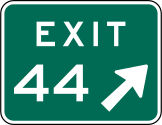
2. A green rectangular sign posted at the point where an off-ramp splits from the freeway shows EXIT with a number and an arrow. What does this sign identify?
- The exit number of the ramp you are entering at the point of separation. (correct)
- The distance in miles to the next numbered exit ahead.
- The route number of the highway the ramp connects to.
Why: The E5-1a combines EXIT and the number at the point the ramp splits from the through lanes, so a driver leaving the freeway sees the ramp identified as they enter it. The distance-based pick is the one to watch: it borrows the mileage from an advance guide sign posted a mile or two before the exit, and a reader who pictures that earlier sign carries the mileage across to the gore. The gore sign carries no distance figure.
Source: Manual on Uniform Traffic Control Devices, sign E5-1a (Exit Gore Sign With Exit Number).
-
3. An ambulance is behind you using its siren and red lights, and you are not in an intersection. What are you required to do?
- Slow to half your speed and keep going in your lane.
- Stop where you are, regardless of your position in the lane.
- Drive to the right edge of the road and stop until it passes. (correct)
Why: California requires you to pull to the right edge of the road and stop until the emergency vehicle passes. Choice B is the tempting miss: drivers reach for the red-light-stop reflex and freeze in whichever lane they are in, which forces the ambulance to weave through traffic instead of passing on a cleared right edge.
Source: California Driver Manual, "Emergency Vehicles," p.45.
-
4. A law enforcement officer suspects you of DUI and asks you to take a blood or urine test. You refuse. What will DMV do to your driving privilege?
- Issue a written warning with no license impact.
- Suspend or revoke it for one year. (correct)
- Require a driving retest but no suspension.
Why: Refusing a blood or urine test triggers a one-year suspension or revocation under California's implied-consent rule. Drivers who carry over a first-refusal warning-letter practice from another state, where an initial chemical-test refusal draws an administrative letter rather than an automatic suspension, reach for Choice A.
Source: California Driver Manual, "SECTION 9. Alcohol and Drugs," p.72.
-
5. After making a full stop at a STOP sign, what does the manual require you to do?
- Wait five seconds even if no vehicles are present
- Check traffic in all directions before proceeding (correct)
- Look only at oncoming traffic before you go
Why: The manual requires a scan in every direction before you move again, because cross traffic can come from any lane at an intersection. The five-second-timing answer comes from a driving-school countdown carried into the exam; the manual describes the traffic check, not a timer.
Source: California Driver Manual, "STOP Sign," p.35.
-
6. A broken white line runs along the right edge of the roadway between the through lane and an exit ramp. What does it permit a driver to do?
- Change lanes across it, into or out of the auxiliary lane, when safe. (correct)
- Stay in the through lane; the edge line marks a hard boundary.
- Pass slower through traffic on the right using the auxiliary lane.
Why: A broken white edge line marks the boundary between a through lane and an auxiliary lane like an exit ramp, and the broken pattern means you may cross it when it is safe, in either direction. A solid white edge line, by contrast, marks a crossing as discouraged, and double solid white lines mark it as prohibited. Drivers who first learned the shoulder edge line, a solid white marking the road's outer edge, often carry that 'do not cross' habit over to every white edge line and never stop to check whether this line's pattern is broken.
Source: Manual on Uniform Traffic Control Devices, marking 3B.06 (Broken White Edge Line).
-
7. What does the manual say about text messages and emails while driving?
- Reading is fine; sending is not.
- Voice-to-text is allowed on the freeway.
- Do not send or read them. (correct)
Why: The manual bans both sending and reading text messages and emails while driving. The pull toward A comes from the intuition that receiving a message is safer than composing one, a split the rule does not recognize.
Source: California Driver Manual, "Cell Phones and Texting," p.70.
-
8. An officer is conducting a law enforcement traffic break ahead of you. What does the manual tell you to do with your emergency flashers?
- Leave them off to avoid confusing the officer
- Turn them on to warn other drivers (correct)
- Flash them once, then turn them off after the officer passes
Why: The manual tells you to turn on your emergency flashers so drivers behind you know the pace ahead is slowing. Choice A assumes flashers might distract the officer, which reverses the manual's point: the flashers are aimed at the drivers behind you, not at the officer.
Source: California Driver Manual, "Law Enforcement Traffic Breaks," p.64.
-
9. At what point does the manual let a child use a properly secured safety belt instead of a child passenger restraint system?
- When they turn 6, regardless of their height.
- When they are 8 years old or older, or at least 4 feet 9 inches tall. (correct)
- When they reach 60 pounds, regardless of age or height.
Why: The manual allows a properly secured safety belt once a child is 8 or older, or at least 4 feet 9 inches tall. Meeting either gate is enough. The 60-pound answer in choice C comes from a booster-seat rule of thumb built around weight; California writes this transition around age and height instead.
Source: California Driver Manual, "Child Restraint System and Safety Seats," p.66.
-
10. May a motorcycle legally share a lane with your vehicle in California?
- Yes, and the manual calls it lane splitting (correct)
- No, motorcycles must always have the full lane
- No, unless traffic is fully stopped
Why: California law makes lane sharing with motorcycles legal, and the manual calls the practice lane splitting. Choice B reflects a driver's instinct to treat one vehicle per lane as an absolute rule; the manual prints both 'give the motorcycle the full lane' and 'lane splitting is legal' in the same section, and only the first is a courtesy.
Source: California Driver Manual, "Motorcycles," p.44.
-
11. A white bicycle symbol painted on the pavement next to a solid white lane line marks the lane as what?
- A portion of the roadway set aside for the preferential use of bicyclists. (correct)
- A shared lane where cars and bikes have equal priority.
- A path reserved for bicycles only, closed to all motor vehicles at all times.
Why: The bike symbol paired with a solid white lane line marks the lane as reserved for the preferential use of bicyclists. The trap is the choice that stretches "preferential" into "exclusive," shutting every motor vehicle out at every hour; that overshoots the rule, because state and local traffic law spell out when other vehicles may enter or cross a bike lane.
Source: Manual on Uniform Traffic Control Devices, marking 9E.01 (Bicycle Lane Symbol).
-
12. Your license is suspended for driving uninsured in a collision. When can you begin to get it back?
- Immediately, once you buy a policy.
- Only after paying the property-damage judgment in full.
- During the last three years of the suspension, with an SR 22/SR 1P. (correct)
Why: You can begin getting your license back during the last three years of the four-year suspension by filing an SR 22/SR 1P and keeping it in force. A driver drawn to A reads buying a policy after the fact as fixing the underlying problem, missing that the suspension runs on its own clock regardless of new coverage.
Source: California Driver Manual, "Driving Without Insurance," p.76.
-
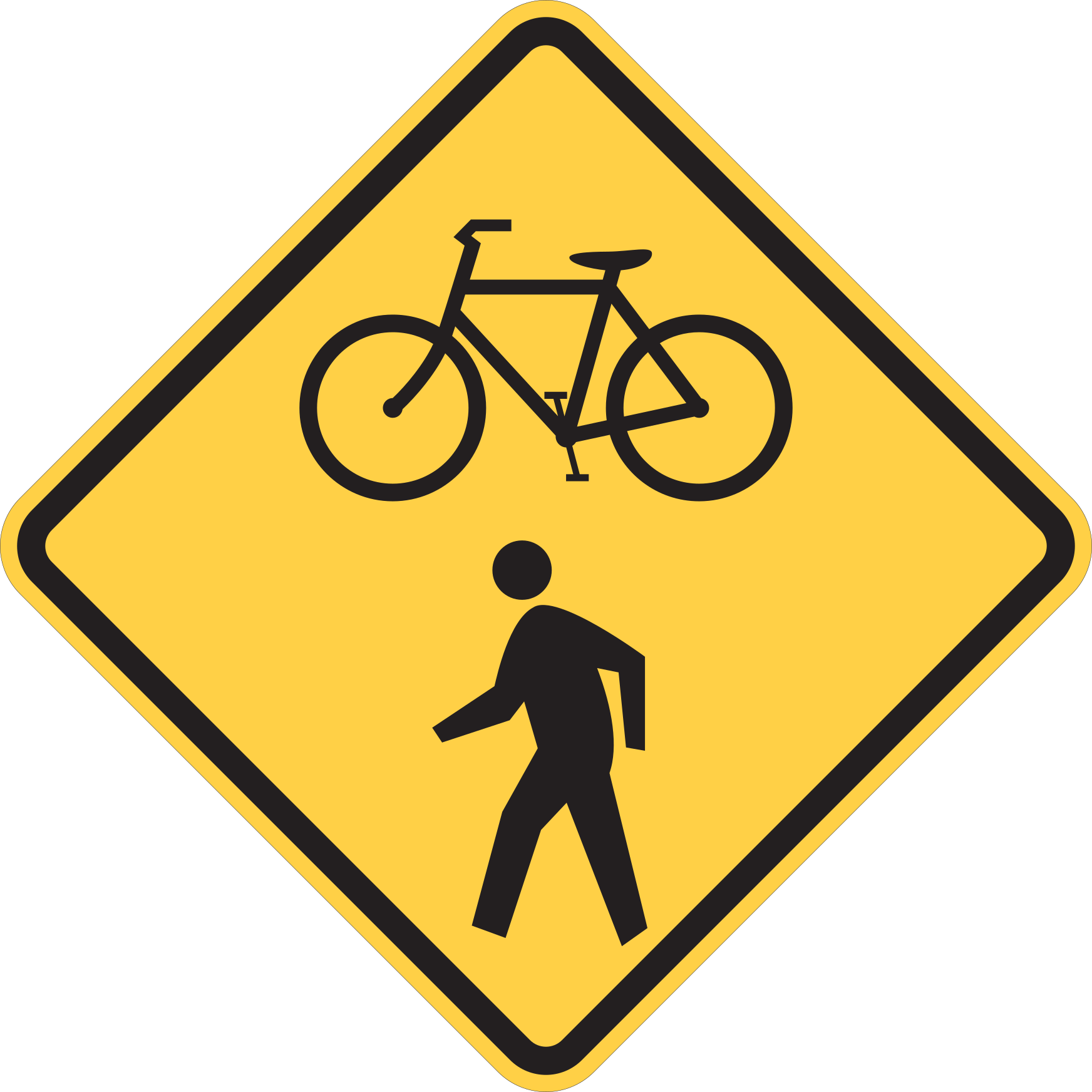
13. What does this warning sign tell a driver to expect on the road ahead?
- A shared crossing used by pedestrians and bicyclists (correct)
- A school crosswalk where children cross the road
- A bike lane beginning along the roadway
Why: The W11-15 warns of a shared crossing where pedestrians and bicyclists may enter the roadway, usually where a sidepath or multi-use trail meets the road at one point. The school-crosswalk reading is the trap because the S1-1 school crossing sign carries the same fluorescent yellow-green background, so the color reads to some drivers as 'children crossing' when it actually flags any non-motorist crossing.
Source: Manual on Uniform Traffic Control Devices, sign W11-15 (Pedestrian and Bicycle Crossing).
-
14. What does a red painted curb tell a driver?
- You may load and unload passengers and freight briefly.
- You may stop briefly to pick up or drop off passengers.
- No stopping, standing, or parking, except a bus at a marked bus zone. (correct)
Why: Red curbs prohibit stopping, standing, or parking, with a narrow exception for buses at red zones marked for buses only. Answer A carries the loading allowance from the yellow-curb entry over to red, since the loading rule and the red rule print one after the other in the manual's short colored-curb list.
Source: California Driver Manual, "Parking at Colored Curbs," p.28.
-
15. You are involved in a collision on private property that causes $1,500 in damage. Must you file a collision report with DMV?
- Skip filing with DMV; the rule applies only to public-road collisions
- File only if the property owner requests a report
- File a report with DMV; the filing rule applies even on private property (correct)
Why: The DMV filing rule follows the damage amount and any injury, and the manual states it applies even if the collision happened on private property. Choice A assumes DMV jurisdiction stops at public roads, reasoning from vehicle-registration frames that do carry a public-road limit.
Source: California Driver Manual, "Reporting a Collision," p.78.
-
16. The word BUS is painted in white in a travel lane. What tells you who may use the lane and during which hours?
- The posted signs at the location (correct)
- Whether the legend spells out BUS ONLY or BUS STOP
- A federal default schedule for bus lanes
Why: The BUS pavement legend identifies a lane or curb zone as bus-designated, but the posted regulatory signs at that location are what state who may enter and when. The trap is the choice that reads the specific legend wording as if BUS ONLY versus BUS STOP carried the schedule itself; the pavement word only supplements the signs, and the signs carry the who and the when.
Source: Manual on Uniform Traffic Control Devices, marking 3E.03 (BUS Pavement Legend).
-
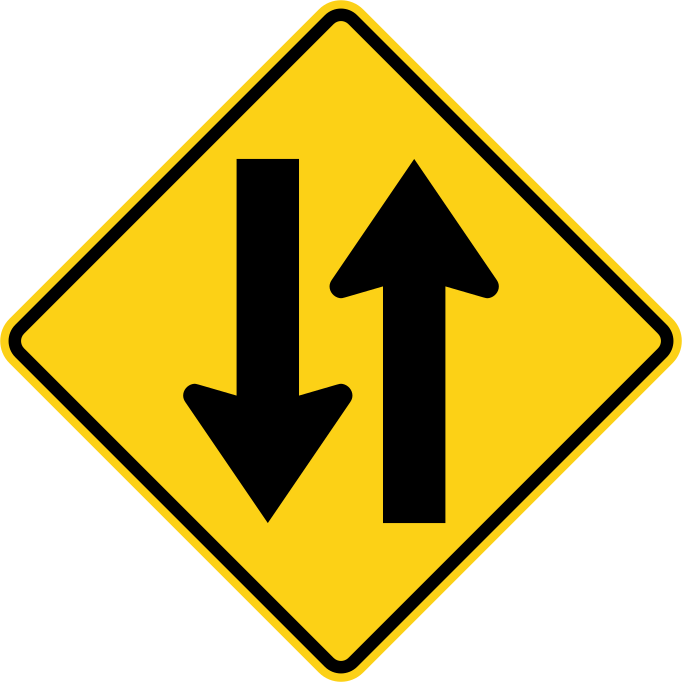
17. What does this Two-Way Traffic sign tell a driver about the road ahead?
- The one-way roadway changes to two-way traffic ahead. (correct)
- A divided highway with a median begins ahead.
- A no-passing zone begins at this sign.
Why: The yellow diamond warns that a one-way roadway is changing to two-way traffic ahead, so you should stay right, hold off on passing, and watch for oncoming vehicles. The trap is the no-passing-zone reading: the entry does say do not pass at this sign, and a learner who fixates on that phrase reaches for the pennant-shaped no-passing zone sign instead of the warning that opposing traffic is about to appear.
Source: Manual on Uniform Traffic Control Devices, sign W6-3 (Two-Way Traffic).
-
18. How far before your turn should you begin signaling?
- About one full block.
- As you reach the crosswalk.
- About 100 feet. (correct)
Why: The manual says to start signaling 100 feet before the turn, giving drivers behind you time to see the signal and slow before you brake. A substitutes the informal 'about a block ahead' rule of thumb some drivers pick up from casual instruction for the specific distance the manual actually prints.
Source: California Driver Manual, "Left Turns," p.19.
-
19. A California applicant is 15 years old and wants to apply for an instruction permit. When may they apply?
- After they reach 15½ years old (correct)
- Immediately, since 15 meets the requirement
- After their 16th birthday
Why: California allows applicants under 18 to begin the instruction permit application at 15½, not at 15 or 16. Answer C tempts applicants who confuse the permit age with the driver's license age of 16, which is a separate later milestone in the same section.
Source: California Driver Manual, "Applying For An Instruction Permit," p.3.
-
20. Under California law, driving while using a handheld cell phone is:
- Allowed if you use the speaker function.
- Allowed on freeways only.
- Unsafe and illegal. (correct)
Why: California law makes driving while using a handheld cell phone unsafe and illegal, with no exception for road type or speaker mode. Drivers who pick A equate tapping speakerphone with hands-free operation, missing that the rule turns on whether the phone is in your hand, not how the audio plays.
Source: California Driver Manual, "Cell Phones and Texting," p.70.
-
21. What does this D9-11b sign tell a driver about services available ahead?
- A public electric vehicle charging station is ahead. (correct)
- Gasoline is sold at a fuel pump ahead.
- A diesel truck stop is located ahead.
Why: The blue square with a fuel pump icon and the letters EV marks a public electric vehicle charging station ahead. The trap is the plain gasoline pump reading, taken by a driver who registers the pump icon and stops there without noticing that the letters on the pump are what name the fuel; on this sign those letters read EV, so the service ahead is charging, not gasoline.
Source: Manual on Uniform Traffic Control Devices, sign D9-11b (Electric Vehicle Charging).
-
22. When may you legally make a U-turn on a divided highway?
- Only during a green traffic light with no NO U-TURN sign.
- Only where a center divider opening is provided. (correct)
- Any time visibility is clear for 500 feet in each direction.
Why: A U-turn on a divided highway is legal only where a center divider opening is provided; crossing a curb, strip of land, or two sets of double yellow lines is banned. Option A imports the intersection U-turn rule into a situation the manual restricts to physical openings in the divider.
Source: California Driver Manual, "U-TURN," p.20.
-
23. What should you do when you approach this Pedestrian Crossing sign?
- Reduce speed and be ready to yield to pedestrians crossing the roadway ahead. (correct)
- Come to a full stop at the sign before continuing through the area.
- Pass the vehicle stopped at the crosswalk if no pedestrian is visible from your lane.
Why: The yellow-green diamond warns that pedestrians may enter the roadway ahead, so slow down and be ready to yield to anyone stepping into or already in the crosswalk. Drivers who fall back on the red-octagon habit of halting at every serious-looking sign pick the come-to-a-full-stop answer instead.
Source: Manual on Uniform Traffic Control Devices, sign W11-2 (Pedestrian Crossing).
-
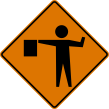
24. You pass a Flagger Ahead sign and enter the work zone. A flagger in the zone waves you through the intersection while the traffic light ahead shows red. What are you required to do?
- Stop for the red light; the traffic light has final authority.
- Follow the flagger's signal and proceed through the intersection. (correct)
- Proceed only if the flagger and the signal both permit it.
Why: A flagger's directions legally override even a traffic light, so when the flagger in the work zone waves you through, you drive past the red. Drivers who stop for the red anyway fall back on the everyday rule that a steady red is always absolute, and miss that the orange diamond warned of a flagger whose directions now outrank the light.
Source: Manual on Uniform Traffic Control Devices, sign W20-7 (Flagger Ahead).
-
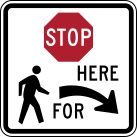
25. What does this Stop Here For Pedestrians sign require of a driver?
- Come to a complete stop for pedestrians at the marked crosswalk on the right. (correct)
- Yield to pedestrians and continue through the crosswalk if it is clear.
- Stop at the sign on every approach, whether or not a pedestrian is present.
Why: The sign is a regulatory instruction to come to a full stop at the stop line for any pedestrian using the marked crosswalk on the right. The trap is the answer that treats it as an unconditional stop on every approach, which borrows the rule from the red octagonal stop sign; this device is triggered by a person in the crosswalk, not by arriving at the sign.
Source: Manual on Uniform Traffic Control Devices, sign R1-5bR (Stop Here For Pedestrians (Right)).
Keep going.
Want explanations one question at a time? Browse every California practice question or jump into the topic study guide. Ready to close the gaps for good? Own the California book and its study system.