Florida Practice Test
A full-length practice test for the Florida DMV knowledge test.
50 Questions Click an answer to reveal the explanation

















Florida Practice Test (50 questions). Correct answers and explanations are noted under each question.
-
1. A Reduction of Lanes sign warns that the right lane is ending ahead. What does the Florida manual tell drivers in the left lane to do?
- Speed up to clear the merge area ahead of them
- Allow the merging drivers to move over smoothly (correct)
- Maintain speed and expect merging drivers to yield
- Move into the ending right lane to hold your place
Why: The manual tells the left-lane driver to allow merging vehicles in smoothly, not to defend the lane. C reads like the highway on-ramp rule, where entering traffic yields to through traffic, but a lane reduction reverses that courtesy and puts the accommodating role on the left-lane driver.
Source: Florida Driver Manual, "Warning Signs: Reduction of Lanes," p.49.
-
2. You are driving through smoke from a wildfire and visibility is low. Which headlight setting does the Florida manual tell you to use?
- Low beam headlights (correct)
- Parking lights only
- Hazard flashers with no headlights
- High beam headlights
Why: In fog, smoke, or heavy rain, low beams are correct because high beams bounce off the moisture or particles and make it harder to see. Choice D tempts drivers whose habit is that brighter always means safer at night; the manual specifically warns that high beams reflect off the fog and worsen visibility.
Source: Florida Driver Manual, "Low Visibility," p.71.
-
3. You are driving on a Florida highway below the speed of surrounding traffic. What does state law require you to do?
- Stay in the left lane and maintain your slower speed
- Turn on your hazard lights to warn following drivers
- Match the speed of surrounding traffic even if it exceeds the posted limit
- Keep to the right so faster vehicles can safely pass (correct)
Why: Florida law tells a driver moving below the flow of traffic to keep right so faster vehicles can pass. Option C (match the flow even past the limit) applies the interstate habit of pacing surrounding traffic, but Florida caps the flow-of-traffic guidance at the posted speed and asks slower drivers to move right rather than speed up.
Source: Florida Driver Manual, "Speed Limits," p.68.
-
4. You are convicted of texting while driving and the violation occurred in a school zone. What does Florida add to the base penalty?
- Automatic license revocation for one year
- A one-year license suspension and fine
- A mandatory ignition interlock installation
- Three additional points on top of the primary offense (correct)
Why: The point table adds three points to the primary texting offense when it occurs in a school zone. Choice A names revocation, which the manual applies to serious offenses such as DUI, certain felonies involving a motor vehicle, and racing on the highway; drivers who assume the school-zone label alone escalates a texting offense onto that list reach for revocation instead of the points enhancement the manual actually adds.
Source: Florida Driver Manual, "Common Violations and Associated Point Value," p.30.
-
5. The word ONLY is painted in white in your travel lane next to a lane-use arrow. What does this require of you?
- Make the movement the arrow indicates. (correct)
- Yield to any driver in the adjacent lane before proceeding.
- Stop at the intersection before making the indicated movement.
- Choose either the arrow's movement or continuing straight ahead.
Why: The ONLY legend, paired with a lane-use arrow, reserves the lane for a single movement, so a driver in that lane must turn or continue as the arrow directs. Drivers who read the arrow as one allowed movement alongside a straight-through default are the ones who miss it, because a lane marked ONLY is never applied to a lane that serves more than one movement.
Source: Manual on Uniform Traffic Control Devices, marking 3B.21 (ONLY Pavement Legend).
-
6. A regulatory sign shows a red circle with a red slash drawn across a symbol. What is it telling you?
- A warning of an upcoming hazard on the road
- A guide to nearby services such as food or fuel
- The action shown inside the circle is required
- The action shown inside the circle is not allowed (correct)
Why: The red circle with a slash is the NO symbol; the sign shows what you are not allowed to do. Readers who look at the pictured symbol first and take it as a command pick C, missing that the slash reverses the meaning and forbids the action rather than requiring it.
Source: Florida Driver Manual, "Traffic Controls, Regulatory Signs (NO symbol)," p.47.
-
7. You see school zone signs ahead. What defensive-driving step does the Florida manual give as an example?
- Focus on the vehicle ahead and match its speed exactly.
- Watch only for the flashing yellow beacons above the sign.
- Assume the crossing guard will stop all traffic when a child crosses.
- Plan what you will do if a child runs or rides into the street. (correct)
Why: The manual gives school zone signs as its example of looking for possible danger: plan what you will do if a child runs or rides into the street. Trusting staffing at the crossing to substitute for the driver's own preparation is what pulls readers to C, but the manual assigns the mental planning to the driver, not the guard.
Source: Florida Driver Manual, "Handling Emergencies: Defensive Driving," p.75.
-
8. Your license and plate are suspended because you failed to maintain the required insurance. Can you obtain a temporary or hardship license to drive to work?
- No, not for any reason, including driving to work (correct)
- Yes, if your employer signs a hardship affidavit
- Yes, once you enroll in a driver improvement course
- Yes, after serving the first 30 days of the suspension
Why: Florida bars a temporary license entirely when the suspension is for lack of insurance, and that bar covers driving to work. Choice C tempts because a driver improvement course does open a business-purposes-only route for point-based suspensions in Florida, and drivers apply that same expectation to an insurance-based suspension that admits no such remedy.
Source: Florida Driver Manual, "Insurance Laws: No-Fault Law," p.24.
-
9. What rear-view mirror requirement does Florida place on your vehicle?
- At least one mirror giving a view of 200 feet behind (correct)
- A power side mirror on the driver's side of the vehicle
- A mirror providing 1,000 feet of rear coverage
- Two outside mirrors plus one inside mirror on every vehicle
Why: Florida's equipment table requires at least one rear-view mirror with a view 200 feet to the rear. Test-takers who carry the 1,000-foot taillight visibility figure over from the row next to the mirror line on the same equipment table are the ones who pick C.
Source: Florida Driver Manual, "Equipment Standards: Required Equipment," p.38.
-
10. What does this INFO sign direct you to?
- A tourist information center or welcome center. (correct)
- A rest area with restrooms and vending machines.
- A hospital with emergency medical services.
- A weigh station for commercial trucks.
Why: The blue square with the white INFO legend marks a tourist information center or welcome center, where traveler information is available. Drivers who read the blue services background as the whole meaning skip past the INFO legend and land on rest area instead.
Source: Manual on Uniform Traffic Control Devices, sign D9-10 (Tourist Information).
-
11. You approach a crosswalk and the vehicle in the lane beside you has stopped there for a pedestrian. What does Florida law say about passing that stopped vehicle?
- You may pass if you first slow to the posted speed limit and check for pedestrians
- You may pass in the daytime after tapping your horn to alert the other driver
- You may pass only if the pedestrian is more than one lane away from your path
- You must not overtake or pass the stopped vehicle (correct)
Why: The manual bans overtaking or passing any vehicle stopped at a crosswalk for a pedestrian, because a driver behind that vehicle cannot see who is stepping out from in front of it. The trap is the tap-your-horn choice, borrowed from the manual's daytime passing signal for two-lane roads; that signal governs normal overtaking, not the crosswalk stop the driver ahead is honoring.
Source: Florida Driver Manual, "You Must Not Pass," p.67.
-
12. What action does Florida law specifically require before you leave your parked vehicle?
- Roll up every window completely
- Take the keys out of the vehicle (correct)
- Point the front wheels straight ahead
- Leave the transmission in Neutral
Why: Florida law names removing the keys as the step required before you leave the vehicle. Drivers who pick D reach for Neutral as a 'safe' middle setting, but the manual requires Park on automatics and Reverse on manuals, so Neutral is neither the required transmission setting nor the step the statute calls out on departure.
Source: Florida Driver Manual, "Parking," p.65.
-
13. According to the Florida manual, which of the following destinations is NOT listed as a place reached by following a blue-and-white service sign?
- Gas stations.
- Hospitals.
- Motels.
- State parks. (correct)
Why: Blue-and-white service signs guide drivers to motorist services, which the manual names as gas, food, motels, and hospitals. State parks are recreation destinations, so the manual assigns them to brown-and-white signs alongside scenic and cultural areas. A driver picks C when the blue category reads as covering only in-transit needs like fuel and medical care, making overnight lodging seem out of place next to gas and hospitals.
Source: Florida Driver Manual, "Traffic Controls: Informational Signs," p.46.
-
14. A white arrow pointing straight ahead is painted in the lane you are driving in as you approach an intersection. What does it require?
- Proceed straight through the intersection (correct)
- Merge into the adjacent lane before the intersection
- Turn either left or right from this lane
- Yield to cross traffic before proceeding straight
Why: The white straight-ahead arrow reserves the lane for through movement; a driver in it must continue forward through the intersection and cannot turn out. The trap is the choice that lets a driver turn left or right from the lane. A reader who learned the two-way turn arrow first tends to carry that "either way" reading over to any painted arrow, but a single arrow points one direction only, and the lane it marks is committed to that direction.
Source: Manual on Uniform Traffic Control Devices, marking 3B.24 (Straight-Through Arrow).
-
15. You want a Florida learner's license. What is the minimum age you must reach before you can apply?
- 15 (correct)
- 18
- 14
- 16
Why: The Florida Driver Manual's Learner's License row opens with "Be at least 15 years old," making 15 the earliest age at which you can apply for the permit. Picking 16, as D does, grabs the age from the Driver License row printed directly below the Learner's License row under the same requirements heading.
Source: Florida Driver Manual, "Requirements for Class E Learner's & Driver License: Learner's License," p.8.
-
16. What does this yellow-green pentagon sign tell you about the road ahead?
- A school zone or school crossing is ahead; slow down and watch for children. (correct)
- A pedestrian crosswalk is ahead; yield to any pedestrian already in the road.
- You are entering a school speed zone; the reduced limit applies whenever you see this sign.
- A stopped school bus with flashing lights is ahead; prepare to stop until the lights go off.
Why: The pentagon shape and fluorescent yellow-green color mark the school advance warning: a school zone or a school crossing is ahead, so slow down and watch for children stepping into the road. The trap is the plain pedestrian-crosswalk reading. Fluorescent yellow-green is also used on general pedestrian warnings, so a driver who keys on color alone and skips over the pentagon outline reaches for the crosswalk answer, when the five-sided shape is reserved for schools.
Source: Manual on Uniform Traffic Control Devices, sign S1-1 (School Advance Warning).
-
17. What should a driver do when approaching this Slippery When Wet sign?
- Reduce speed and avoid sudden moves like hard braking. (correct)
- Come to a full stop before continuing onto the wet pavement.
- Pull off the roadway until the pavement fully dries.
- Turn on hazard lights and maintain the posted speed.
Why: The sign warns that the road surface ahead loses traction in rain, snow, or ice, so you ease off the accelerator, add following distance, and keep every input on the wheel and pedals gentle. The trap is the choice that calls for a full stop; a yellow warning diamond flags what to expect, and a driver who reaches for the stop-sign rule at every diamond is applying a regulatory response to a caution.
Source: Manual on Uniform Traffic Control Devices, sign W8-5 (Slippery When Wet).
-
18. The Florida manual lists blue as a color used for driver guidance. Besides motorist services, what else does the blue color identify?
- Active school and pedestrian zones
- Construction and detour warnings
- Wildlife crossings on rural highways
- Parking spaces for disabled drivers (correct)
Why: Blue guides drivers to motorist services and, per the manual's color table, marks parking spaces reserved for people with disabilities. Choice A stretches blue into a general safety-critical color, borrowing from the fluorescent yellow-green the manual actually assigns to school and pedestrian activity.
Source: Florida Driver Manual, "Traffic Sign Colors," p.46.
-
19. You are on a two-lane road that climbs and curves ahead. Under Florida law, what minimum sight distance must you have before you may start a pass?
- 1,000 feet
- 100 feet
- 200 feet
- 500 feet (correct)
Why: Florida's rule sets a fixed minimum: you must be able to see at least 500 feet down the road before you pass on a hill or curve. Drivers who miss this usually reach for the 200-foot return-to-lane cushion in choice C and apply that figure to the wrong step of the pass.
Source: Florida Driver Manual, "Passing," p.67.
-
20. You are about to overtake a bicyclist on a Florida road. What minimum clearance must you leave between your vehicle and the bicyclist?
- Five feet
- One foot
- Three feet (correct)
- Two feet
Why: Florida law requires a minimum of three feet of clearance when passing a bicyclist. Drivers who carry over another state's four- or five-foot bicyclist-buffer rule overshoot Florida's three-foot minimum and pick five feet.
Source: Florida Driver Manual, "Sharing the Road: Bicyclists (Rules for Motorists)," p.81.
-
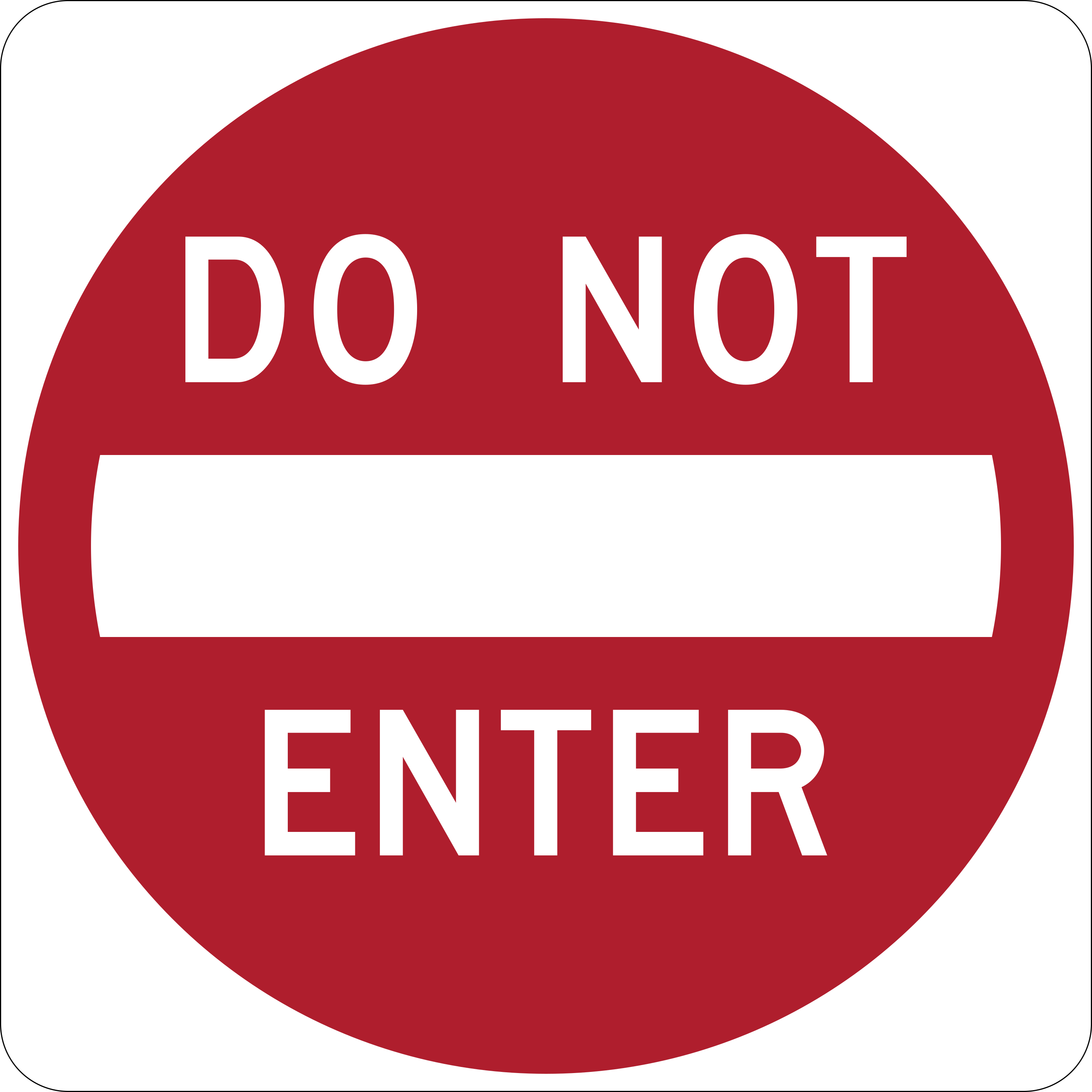
21. Where is a Do Not Enter regulatory sign posted?
- On one-way streets and roadways where you may not enter. (correct)
- In front of construction zones with workers actively present.
- Only along the exit ramps of a limited access highway.
- At the end of a divided highway where two-way traffic resumes.
Why: Do Not Enter guards the entry to a one-way street or roadway where entering would put you against traffic. Narrowing the sign to expressway ramps, as choice C does, ties it to the Wrong Way sign that shares that setting.
Source: Florida Driver Manual, "Regulatory Signs: Do Not Enter," p.47.
-
22. What does a Florida work-zone flagger use to direct traffic?
- Amber paddles and an air horn.
- A whistle and hand claps.
- Red flags or signs. (correct)
- Green flags or lighted batons.
Why: Flaggers use red flags or signs to direct traffic. Learners who key amber paddles are borrowing the amber color that identifies directional signals earlier in the same chapter, not the red color the manual assigns to flagger tools.
Source: Florida Driver Manual, "Construction/Maintenance Signs & Signals," p.54.
-
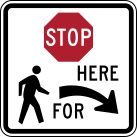
23. What does this Stop Here For Pedestrians sign require of a driver?
- Come to a complete stop for pedestrians at the marked crosswalk on the right. (correct)
- Yield to pedestrians and continue through the crosswalk if it is clear.
- Stop at the sign on every approach, whether or not a pedestrian is present.
- Slow down and watch for people who may cross the road ahead.
Why: The sign is a regulatory instruction to come to a full stop at the stop line for any pedestrian using the marked crosswalk on the right. The trap is the answer that treats it as an unconditional stop on every approach, which borrows the rule from the red octagonal stop sign; this device is triggered by a person in the crosswalk, not by arriving at the sign.
Source: Manual on Uniform Traffic Control Devices, sign R1-5bR (Stop Here For Pedestrians (Right)).
-
24. What should a driver do when approaching this Divided Highway Ends sign?
- Keep right and be ready for oncoming traffic in the lane next to you. (correct)
- Merge left because the right lane ends ahead.
- Yield to traffic entering from a road that joins on the right.
- Prepare to stop because two one-way roadways are ending at an intersection.
Why: The two separated one-way roadways are about to merge back into one two-way road, so keep right and be ready for opposing traffic in the lane next to you. Passing here is risky because the neighboring lane now carries vehicles coming toward you rather than traveling with you. Drivers who read the word 'ends' on a yellow diamond as a lane drop reach for the merge-left answer, treating this the way they would a lane-reduction warning that uses the same shape and color.
Source: Manual on Uniform Traffic Control Devices, sign W6-2 (Divided Highway Ends).
-
25. Which category of driver distraction is defined as thinking about anything other than driving?
- Cognitive (correct)
- Manual
- Emotional
- Visual
Why: The manual names Cognitive distraction and defines it as thinking about anything other than driving. Eyes off the road is the image drivers picture first when they hear 'driver distraction,' which pulls them toward D and past the separate label the manual gives to a mind not on driving.
Source: Florida Driver Manual, "Distracted Driving: Categories of Distraction," p.34.
-
26. You are in the left lane and see this sign in a work zone. What does it require of you?
- Signal, match traffic speed in the right lane, and merge right before the taper. (correct)
- Stop at the taper and wait for a gap in traffic before merging.
- Race to the taper and cut in ahead of continuing traffic.
- Stay in the left lane; traffic in the right lane must yield to you.
Why: In a work-zone lane closure, the driver in the ending lane signals, matches the speed of the through lane, and merges right well before the taper. Racing to the taper and cutting in ahead of continuing traffic tempts drivers who treat the closure as a chance to gain position, the aggressive habit this advance warning is placed to prevent.
Source: Manual on Uniform Traffic Control Devices, sign CW4-2L (Lane Ends Merge Right (Work Zone)).
-
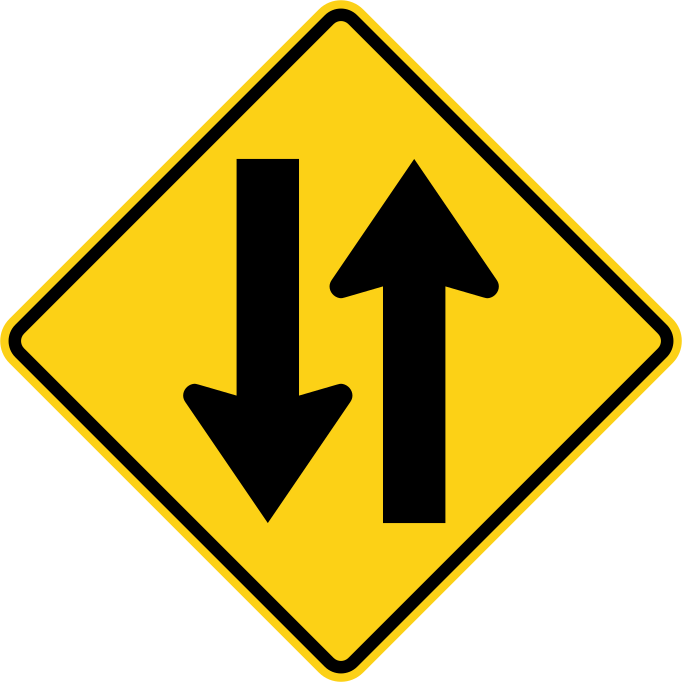
27. A yellow diamond warning sign shows two arrows pointing in opposite directions. What does the Florida manual say it warns about?
- You must choose a left or right exit at a fork.
- The road is about to change to two-way traffic with oncoming vehicles. (correct)
- The center lane is a shared left-turn lane.
- A divided highway with a physical median begins ahead.
Why: A Two-Way Traffic Ahead sign warns that the roadway is changing to two-way flow with oncoming traffic, so stay right and watch for vehicles in the other lane. The Divided Highway Ahead answer traps test-takers who see two opposing arrows and read them as a median beginning rather than as a switch in traffic flow.
Source: Florida Driver Manual, "Warning Signs: Two-Way Traffic Ahead," p.49.
-
28. In a Florida work zone, what may direct you to reduce speed and use caution?
- Any driver ahead of you signaling with hazard lights.
- A sign, a flagger, or a law enforcement officer. (correct)
- Only a uniformed law enforcement officer on scene.
- Only the construction supervisor wearing a hard hat.
Why: The manual tells you to reduce speed and use caution when directed to do so by a sign, a flagger, or a law enforcement officer in a work zone. Drivers who picture only the uniformed officer on scene default to A, treating badge authority as the only kind that counts and dropping the flagger and posted sign the manual names beside the officer.
Source: Florida Driver Manual, "Construction/Maintenance Signs & Signals," p.54.
-
29. You are parking uphill on the shoulder of a road that has no curb. Which way should you turn your front wheels?
- Whichever way the shoulder slopes
- To the right (correct)
- To the left
- Straight ahead
Why: With no curb to catch a rollback, Florida directs you to turn the front wheels right so a rolling vehicle heads onto the shoulder rather than into the travel lane. Drivers who carry over the "away from curb" rule from the uphill-with-curb case pick C, applying its mirror-image direction to a shoulder that has no curb to stop the wheel.
Source: Florida Driver Manual, "Parking on Hills: Uphill without Curb," p.66.
-
30. How close to a fire hydrant does Florida law let you park?
- No closer than 20 feet
- No closer than 25 feet
- No closer than 10 feet
- No closer than 15 feet (correct)
Why: Florida law bans parking within 15 feet of a fire hydrant so responders can reach it. C rounds the manual's figure down to a familiar 10-foot number drivers hear in generic fire-clearance guidance rather than the distance the hydrant rule itself sets.
Source: Florida Driver Manual, "It's Against the Law to Park," p.66.
-
31. Besides making a turn at an intersection, in which situation does Florida law require you to use your turn signal?
- When backing up out of a parking space.
- When changing lanes or overtaking another vehicle. (correct)
- Only when other traffic is visible within 100 feet.
- Only when making turns at intersections.
Why: Florida law requires signals for turning, changing lanes, and overtaking. Drivers who read the phrase 'turn signal' literally reach for option D, but the same signal is required any time you cross into another lane, including passing another vehicle.
Source: Florida Driver Manual, "Turning," p.69.
-
32. You are driving your own car in Florida. What proof of insurance does state law require you to have with you?
- A copy of your insurance filing stamped by the county clerk
- A photocopy of the full policy stored in the glovebox
- A signed letter from your insurance agent describing your coverage
- The Florida Insurance ID Card or electronic proof on a smartphone (correct)
Why: The manual requires drivers to carry the insurer-issued Florida Insurance ID Card or electronic proof on a smartphone. Drivers who assume a fuller document must be better evidence pick the glovebox policy in choice B instead of the small card the insurer actually issues.
Source: Florida Driver Manual, "Insurance Laws: No-Fault Law," p.23.
-
33. A center travel lane is bordered on each side by an outer solid yellow line and an inner broken yellow line. What is this lane used for?
- Left turns by traffic traveling in either direction. (correct)
- Passing slower vehicles when the adjacent through lane is blocked.
- Left turns made only by oncoming traffic from the opposite direction.
- Through travel to bypass congestion in the adjacent lane.
Why: A center lane bordered by outer solid and inner broken yellow lines is a two-way left-turn lane, used by traffic from both directions only to make left turns. The trap is the choice that treats the broken yellow line as a passing line; on a two-lane road a broken yellow line does permit passing, but here the broken line only marks where vehicles may cross into the lane to turn left, and passing inside the lane is not allowed.
Source: Manual on Uniform Traffic Control Devices, marking 3B.05 (Two-Way Left-Turn Lane).
-
34. What does this warning sign tell a driver about the road ahead?
- Two roads merge together and traffic from the right will enter your lane.
- A side road enters from the right ahead at roughly a right angle. (correct)
- The road ahead ends at a T-intersection where you must turn.
- Roads cross the main roadway from both sides ahead.
Why: The Side Road (Right) sign warns that a road joins the main roadway from the right ahead at roughly a right angle, so watch for vehicles entering or pulling out from that side road. The trap is the crossroad sign, which shows entering roads on both sides; a driver who glances at the diamond without noting that only the right arm is drawn reaches for the crossroad warning instead.
Source: Manual on Uniform Traffic Control Devices, sign W2-2R (Side Road (Right)).
-
35. The word STOP is painted in white across your travel lane. What does this pavement legend tell you?
- A stop sign or signal is ahead, and you must prepare to come to a complete stop. (correct)
- The legend itself is the stop line where the front wheels must halt.
- Cross traffic ahead has the right of way at an uncontrolled intersection.
- A rolling stop is allowed when the intersection ahead is clear.
Why: The STOP legend on the pavement reinforces an upcoming stop sign or signal and warns you to prepare to bring the vehicle to a complete stop. The trap is the choice that treats the painted word as the stop line itself; the legend typically appears just before a transverse stop bar, so the line you halt behind is that bar, not the word painted on the approach.
Source: Manual on Uniform Traffic Control Devices, marking 3B.20 (STOP Pavement Legend).
-
36. A yellow diamond warning sign shows a leaping deer. What does the Florida manual say this sign means?
- A wildlife facility releases deer that cross the road here.
- Reduce your speed to the posted advisory speed.
- A state wildlife refuge exit is coming up on this road.
- Watch for the pictured animal crossing at twilight and nighttime. (correct)
Why: The animal crossing sign warns that the pictured species is common in the area and that crossings peak at twilight and nighttime, so scan the shoulders as the light fades. Drivers who pair any wildlife image with the brown-and-white recreation signs pointing to parks and preserves reach for the state wildlife refuge answer instead.
Source: Florida Driver Manual, "Warning Signs: Animal Crossing," p.50.
-
37. A Must Turn regulatory sign showing arrows in both directions is posted at an intersection. What does it require of you?
- You must turn only in the direction of the single arrow shown.
- You must yield to turning traffic before continuing straight.
- You must turn right or left; you cannot continue straight ahead. (correct)
- You may turn or continue straight at your discretion.
Why: The dual-arrow Must Turn sign bans going straight and lets the driver choose either direction. The single-direction reading carried into choice A comes from Left Lane Must Turn, whose shared name pulls readers toward the wrong rule.
Source: Florida Driver Manual, "Regulatory Signs: Must Turn," p.48.
-
38. You are about to overtake another vehicle in the daytime on a two-lane road. What does the manual say you should do to let the other driver know you are passing?
- Sound a long, steady horn blast
- Turn on the hazard lights
- Flash the high-beam headlights
- Tap the horn briefly (correct)
Why: In daylight the driver ahead may not notice you in their mirrors, so the manual pairs a brief horn tap with day and a headlight flash with night to alert them. Drivers who treat those two signals as interchangeable and carry the nighttime headlight flash over to a daytime pass are the ones who pick C.
Source: Florida Driver Manual, "Passing," p.67.
-
39. You are driving on a through street and approach an intersection with a green horizontal rectangle sign posted overhead. What does this D3-1 street name sign identify?
- The name of the cross street you are about to reach at the intersection. (correct)
- The name of the street you are currently traveling along right now.
- The remaining distance to the next town along your current route.
- The number of a numbered highway route you are approaching soon.
Why: A D3-1 street name sign is a guide sign posted at an intersection, and on a through street it names the cross street you are about to reach so you know which turn is coming up. The tempting wrong pick is the choice about the street you're currently on, which mirrors how a passenger reads a street sign on a residential block as confirmation of the road the car is already on; at a through-street intersection the D3-1 label goes to the crossing roadway instead.
Source: Manual on Uniform Traffic Control Devices, sign D3-1 (Street Name Sign).
-
40. A public transit bus ahead of you has signaled and is pulling out of a designated pullout bay back into your lane. What does Florida law require of you?
- Maintain speed; the bus must wait for a full gap in traffic
- Yield only if the bus has flashing red lights activated
- Change lanes to the left; yielding is not required
- Yield the right-of-way and let the bus reenter traffic (correct)
Why: A transit bus that has signaled and is reentering traffic from a designated pullout bay in your direction of travel gets the right-of-way. Choice A is the trap for drivers who apply the standard merging rule (the entering driver yields) and miss that Florida flips it for public transit buses leaving a pullout bay.
Source: Florida Driver Manual, "Public Transit," p.88.
-
41. You are 16 and just received your Florida learner's license today. During what hours does state law allow you to drive?
- Any hours as long as a licensed adult rides along
- Only during daylight hours (correct)
- Any hours until 10 pm
- Any hours except 11 pm to 6 am
Why: For the first three months after you receive a Florida learner's license as a minor, state law limits you to daylight hours with a licensed driver age 21 or older in the car. The 10 pm answer catches drivers who read the follow-on sentence as the day-one rule and skip past the three-month qualifier printed just ahead of it.
Source: Florida Driver Manual, "Restrictions for Minors (Driving Curfews)," p.25.
-
42. An extra-wide solid white line runs along the right side of the roadway. What does it tell you as a driver?
- Keep the line on your left and stay off the shoulder. (correct)
- Cross the line to pass slower traffic on the right.
- Stop your vehicle before crossing the line ahead.
- The lane is reserved for bicycles only.
Why: An extra-wide solid white edge line marks where the travel lane ends on the right, and the driver keeps it on the left while treating the shoulder beyond it as off-limits for normal driving. The tempting wrong choice reads the line as a broken lane divider that a driver may cross to move right, a rule that belongs to dashed white lines between two through lanes, not to an edge line whose whole job is to mark the outer boundary of the lane you are already in.
Source: Manual on Uniform Traffic Control Devices, marking 3B.06 (Wide Solid White Edge Line).
-
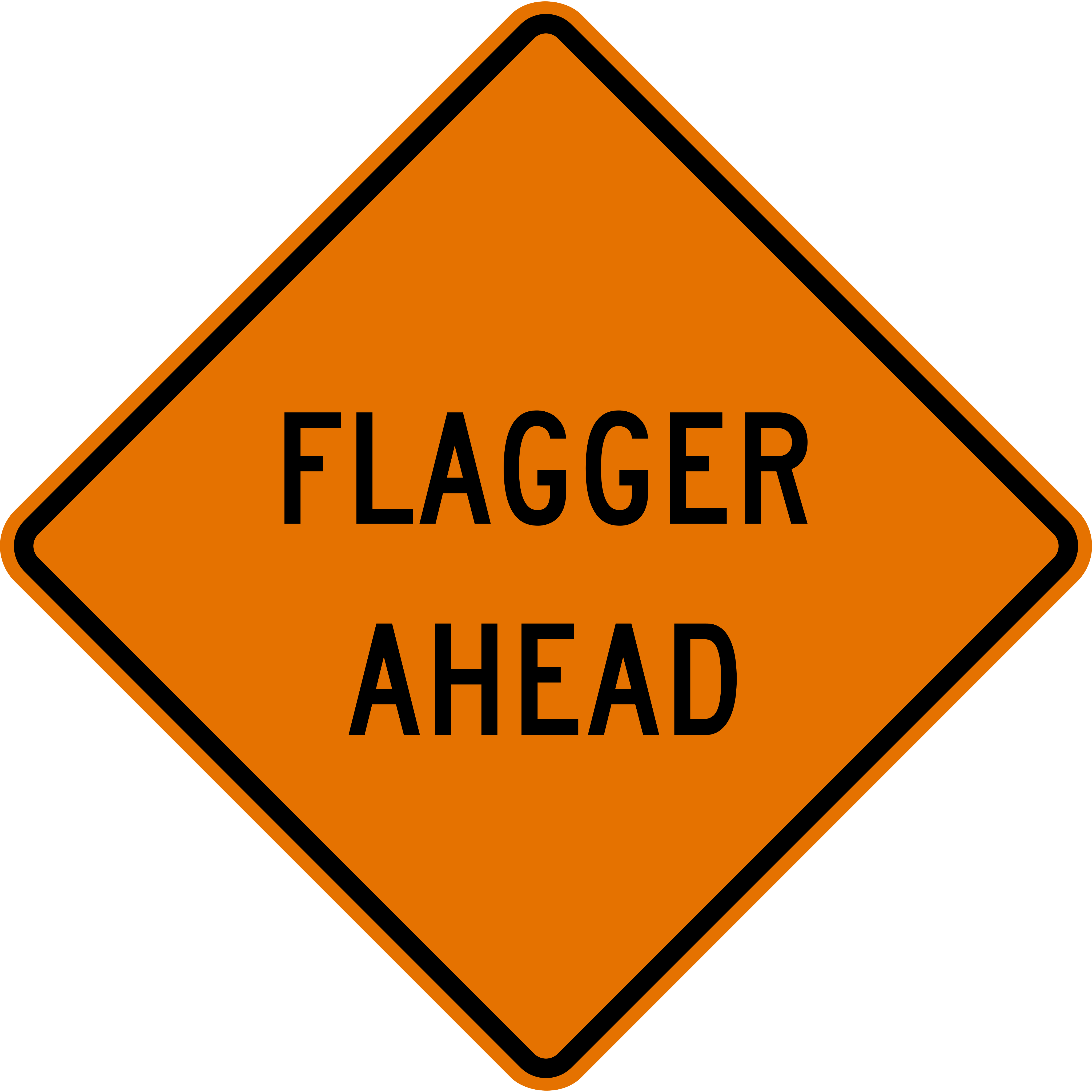
43. What does this Flagger Ahead sign require of a driver approaching the work zone?
- Obey the hand signals of the flagger directing traffic ahead. (correct)
- Follow the pavement markings through the work zone until they end.
- Follow the traffic light at the next intersection ahead.
- Merge left because a lane is closed ahead of the sign.
Why: The sign warns that a person is directing traffic in the work zone ahead, and their hand signals govern how you move through it. The trap is the answer that keeps you obeying the next traffic light; the entry is explicit that a driver takes direction from the flagger rather than from the signal or the markings when both are present.
Source: Manual on Uniform Traffic Control Devices, sign W20-7a (Flagger Ahead (Word Message)).
-
44. Which of the following is exempt from Florida's safety belt requirements?
- A driver with a chronic back injury who finds seat belts uncomfortable.
- A rideshare driver working a late-night shift.
- A pickup truck driver whose vehicle has a net weight under 26,000 pounds.
- An employee of a newspaper home delivery service while delivering papers. (correct)
Why: Florida's safety belt exemption list is short and specific, and an employee of a newspaper home delivery service qualifies while actually delivering papers. Choice C reads the 26,000-pound threshold as a ceiling rather than a floor: the exemption covers only trucks over that weight (semis and heavy commercial rigs) while ordinary pickups sit well below that line and stay on the hook.
Source: Florida Driver Manual, "Safety Belts and Child Passenger Safety: Exemptions," p.28.
-
45. The manual describes noticing an aggressive driver changing lanes as they close on you from behind. What does it tell you to anticipate and do?
- Anticipate they will tailgate; speed up to match the flow of traffic ahead.
- Anticipate they will pull alongside; hold your lane position firmly.
- Anticipate they will pass and cut you off; slow down and be ready to brake. (correct)
- Anticipate they need to exit; move left to give them room to the shoulder.
Why: The manual's example says to anticipate the aggressive driver will pass and cut you off, then slow down and be ready to brake. Choosing A falls back on the freeway habit of matching prevailing speed to shed a tailgater, but that response matches the aggressive driver's pace and closes the gap you need to brake safely.
Source: Florida Driver Manual, "Handling Emergencies: Defensive Driving," p.75.
-
46. Outside a crosswalk, you see yellow or white diagonal stripes painted on the pavement ahead. What do those stripes mark?
- Shared-use lanes for buses and bicycles.
- School crossing zones ahead of intersections.
- Areas reserved for emergency stopping only.
- Fixed obstructions such as medians. (correct)
Why: Yellow or white diagonal stripes mark fixed obstructions such as medians and no-parking zones, and you must not drive through them. Choice B tempts drivers who know marked crosswalks can also be filled with white diagonal lines and then apply that pedestrian-crossing pattern to any diagonal striping they see on the pavement.
Source: Florida Driver Manual, "Pavement Markings - Other Markings," p.46.
-
47. A solid yellow line runs down the middle of a two-way roadway, separating your lane from oncoming traffic. What does it require of you?
- Stay right of the line and do not cross it to pass slower vehicles. (correct)
- Pass slower vehicles ahead when the way looks clear.
- Cross the line at will to reach any driveway, alley, or side road.
- Make no left turn across the line at any point.
Why: A solid yellow line down the center of a two-way road separates opposing traffic and closes passing on your side. You keep to the right of it and cross it only to make a permitted left turn into a driveway, alley, or side road, and only when it is safe. The trap is the choice that reads the marking as a broken yellow line and treats a clear road ahead as permission to overtake. A solid stroke has already settled the passing decision against you, regardless of how clear the road looks at the moment.
Source: Manual on Uniform Traffic Control Devices, marking 3B.01 (Solid Yellow Center Line).
-
48. What does this sign require of a driver in the right lane?
- Merge left into the adjacent through lane because the right lane is ending ahead. (correct)
- The left lane is closing, so shift one lane to the right.
- Stay in the right lane, which becomes an exit-only lane at the ramp ahead.
- A new right lane is being added ahead, and through traffic may move into it.
Why: This yellow diamond warns that the right lane is closing, so a driver in it must signal, find a gap, and merge into the adjacent through lane on the left before the pavement drops. The trap is the answer that flips the merge direction; a driver who mixes this sign up with Left Lane Ends reads the tapered side as the left lane and moves right into a lane that has no reason to yield to them.
Source: Manual on Uniform Traffic Control Devices, sign W4-2R (Lane Ends (Right Lane Ends)).
-
49. A solid white line runs along the right side of the roadway. What does it mark?
- The right edge of the travel lane and the boundary with the shoulder (correct)
- The centerline between traffic moving in opposite directions
- The boundary between two travel lanes going the same direction
- A zone where passing other vehicles is prohibited
Why: A solid white line on the right side of the road marks the right edge of the travel lane and separates the lane from the shoulder. The trap is the same-direction lane choice: white does divide lanes moving the same way, and a driver applying that broad rule can miss that this particular line hugs the shoulder rather than sitting between two travel lanes.
Source: Manual on Uniform Traffic Control Devices, marking 3B.06 (Solid White Right Edge Line).
-
50. You reach an intersection where you meant to turn, but you are not in the proper lane for the turn. What does the Florida manual tell you to do?
- Make the turn from your current lane and merge quickly
- Drive to the next intersection and turn from the proper lane there (correct)
- Signal and cut across to the correct lane before the turn
- Stop in your current lane and back into the proper one
Why: The manual is direct: if you are not in the proper lane at your intended intersection, drive on to the next intersection and make the turn from the proper lane there. Answer D adapts a parking-lot backing habit to open traffic, proposing to back into the proper lane rather than continue ahead to the next intersection.
Source: Florida Driver Manual, "Turning," p.70.
Keep going.
Want explanations one question at a time? Browse every Florida practice question or jump into the topic study guide. Ready to close the gaps for good? Own the Florida book and its study system.