Nevada Practice Test
A full-length practice test for the Nevada DMV knowledge test.
25 Questions Click an answer to reveal the explanation







Nevada Practice Test (25 questions). Correct answers and explanations are noted under each question.
-
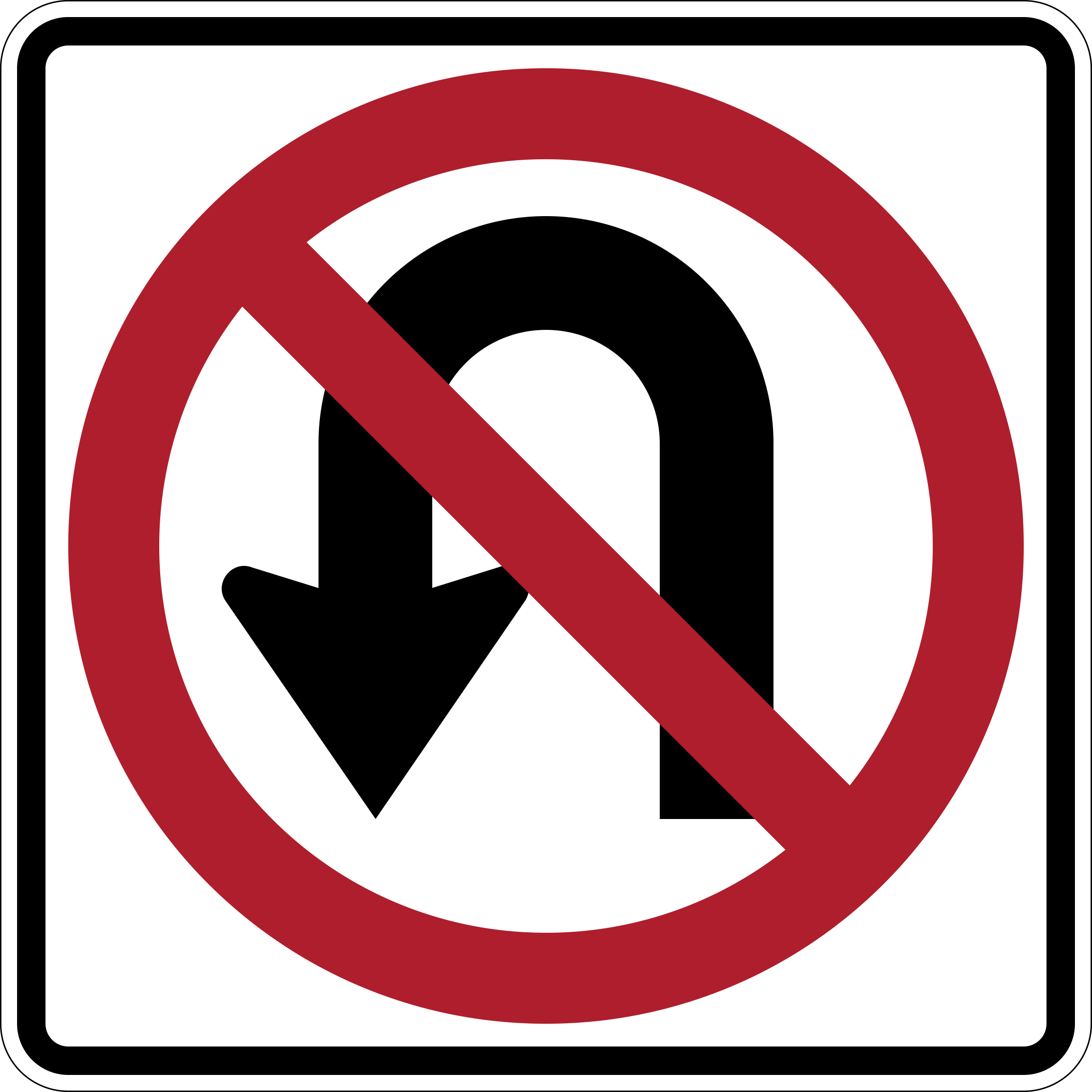
1. You approach this No U-Turn sign and need to reverse your direction of travel. What does the sign require?
- Continue past and use a designated turnaround or another intersection. (correct)
- Complete the U-turn only when the road is clear of oncoming traffic.
- Complete the U-turn only from the leftmost lane on a green signal.
- Turn left here instead, since the sign forbids only left turns.
Why: A No U-Turn sign forbids reversing direction by turning 180 degrees through this intersection or median opening, so a driver who needs to turn around continues past and uses a designated turnaround or another intersection where U-turns are allowed. Drivers who read the sign as a yield-style caution pick the answer that waits for a clear oncoming lane; the sign is a prohibition, not a caution about traffic, and a clear lane does not make the U-turn legal here.
Source: Manual on Uniform Traffic Control Devices, sign R3-4 (No U-Turn).
-
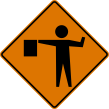
2. You pass a Flagger Ahead sign and enter the work zone. A flagger in the zone waves you through the intersection while the traffic light ahead shows red. What are you required to do?
- Stop for the red light; the traffic light has final authority.
- Follow the flagger's signal and proceed through the intersection. (correct)
- Stop and wait until the signal turns green, then proceed.
- Proceed only if the flagger and the signal both permit it.
Why: A flagger's directions legally override even a traffic light, so when the flagger in the work zone waves you through, you drive past the red. Drivers who stop for the red anyway fall back on the everyday rule that a steady red is always absolute, and miss that the orange diamond warned of a flagger whose directions now outrank the light.
Source: Manual on Uniform Traffic Control Devices, sign W20-7 (Flagger Ahead).
-
3. A broken white line separates your lane from the lane to your left, both traveling in the same direction. What does this marking permit?
- Lane changes across the line when it is safe to do so. (correct)
- Passing by crossing into oncoming traffic.
- Crossing only in an emergency.
- Nothing; the line must not be crossed.
Why: A broken white line divides lanes moving the same way, and a driver may cross it to change lanes whenever the move is safe: signal, check mirrors and blind spots, then move over. The choice about passing into oncoming traffic reaches for the rule that governs broken yellow center lines on two-way roadways; broken white never sits between opposing lanes and has nothing to do with oncoming vehicles.
Source: Manual on Uniform Traffic Control Devices, marking 3B.04 (Broken White Lane Line).
-
4. This pavement marking is painted across your lane at a stop-controlled intersection. Where must you bring your vehicle to a stop?
- Before any part of the vehicle crosses the line. (correct)
- With the front bumper directly over the line.
- At the curb of the cross street.
- Anywhere within one car length past the line.
Why: The stop line marks the exact boundary the vehicle must remain behind at a stop sign or red signal; the entry says to bring the front of the vehicle to a complete halt before any part of it crosses the line. The tempting wrong pick is stopping with the bumper directly over the line: drivers read the bar as a target to line up with rather than a boundary they may not cross, so they pull forward until the front wheel or bumper rests on the paint.
Source: Manual on Uniform Traffic Control Devices, marking 3B.16 (Stop Line).
-
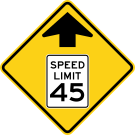
5. What does this Reduced Speed Limit Ahead sign require of a driver?
- Begin slowing so your speed is at or below the new limit by the regulatory sign that follows. (correct)
- Immediately drop to the value shown the moment you pass this sign.
- Slow only if current road conditions make the posted limit unsafe.
- Hold current speed until you reach the new regulatory speed-limit sign.
Why: This sign is advance notice. Begin slowing now so your speed is at or below the new limit by the time you reach the regulatory sign that actually posts it. The trap is the choice that says drop to the shown value the moment you pass the diamond. That reads the yellow warning as if it were the black-on-white regulatory posting, but a yellow diamond never sets the enforceable limit; the regulatory sign that follows does.
Source: Manual on Uniform Traffic Control Devices, sign W3-5 (Reduced Speed Limit Ahead).
-
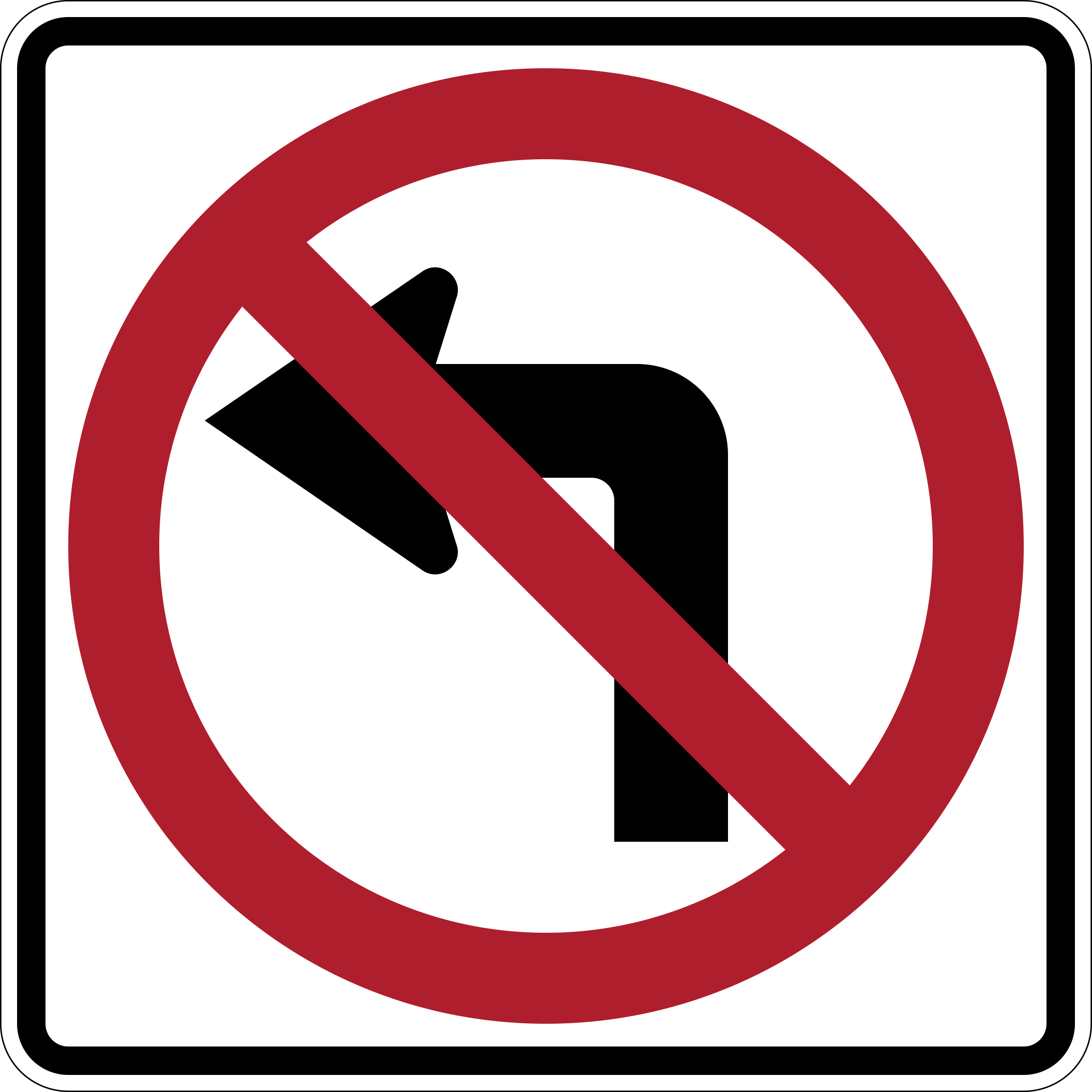
6. What does this No Left Turn sign require of a driver in the lane where it is posted?
- Continue straight or use another approved movement; a left turn from that lane is prohibited. (correct)
- Make the left turn only after coming to a complete stop and yielding to oncoming traffic.
- Make the left turn only when a green arrow is displayed on the traffic light.
- The prohibition applies only during the hours shown on a plaque mounted below the sign.
Why: The sign forbids a left turn from that lane at any time, so a driver must continue straight or use another approved movement. The trap is the time-of-day answer, which reads the exception as the base rule; a supplemental time plaque is needed to limit the prohibition to certain hours, and without one the sign applies full-time.
Source: Manual on Uniform Traffic Control Devices, sign R3-2 (No Left Turn).
-
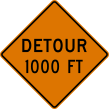
7. What does this Detour Ahead sign tell a driver about the road ahead?
- The road ahead is closed and traffic will follow a marked detour route. (correct)
- One lane ahead is closed but the road stays open to through traffic.
- A flagger is directing traffic through the work zone ahead.
- Workers are on or near the shoulder in the work zone ahead.
Why: W20-2 warns that the road ahead is closed and traffic is sent around the work zone on a marked detour, so past this point you stop navigating by memory and start reading the orange DETOUR markers. The pull toward the lane-closure answer comes from drivers who've mostly met work-zone signs that shift traffic within the same road; the detour warning is used when the through route itself is shut, not narrowed.
Source: Manual on Uniform Traffic Control Devices, sign W20-2 (Detour Ahead).
-
8. You were in a fender bender with no injuries, and your vehicle can move safely. What does the Nevada manual say to do?
- Continue driving if the damage looks minor.
- Leave both vehicles in place until an officer arrives.
- Move to a location that does not obstruct traffic and return to the scene. (correct)
- Drive straight to the nearest police station to file a report.
Why: For a crash with only vehicle damage and no injuries, the manual tells you to move a drivable vehicle out of the traffic lane so you do not block traffic, then return to the scene to exchange information with the other driver.
Source: Nevada Driver Manual, "What to Do in a Crash," p.76.
-
9. The Nevada manual requires headlights whenever persons or vehicles cannot be clearly seen at what distance?
- 500 feet
- 750 feet
- 1,000 feet (correct)
- 1,500 feet
Why: This is one of the four legal triggers for headlights listed in Night Driving. It stands separate from the half-hour-after-sunset rule and the high-beam dim rules, and it uses a specific distance that is easy to confuse with the 500-foot high-beam dim distance.
Source: Nevada Driver Manual, "Chapter 5, Night Driving," p.56.
-
10. What does this INFO sign direct you to?
- A tourist information center or welcome center. (correct)
- A rest area with restrooms and vending machines.
- A hospital with emergency medical services.
- A weigh station for commercial trucks.
Why: The blue square with the white INFO legend marks a tourist information center or welcome center, where traveler information is available. Drivers who read the blue services background as the whole meaning skip past the INFO legend and land on rest area instead.
Source: Manual on Uniform Traffic Control Devices, sign D9-10 (Tourist Information).
-
11. In a Nevada highway work zone, what does an orange speed limit sign mean?
- It carries the same regulatory force as a black-and-white speed limit sign.
- It is advisory and indicates slower, safer speeds. (correct)
- It applies only when construction workers are physically present.
- It replaces the state maximum speed limit along the entire route.
Why: The manual states orange work-zone speed limit signs are advisory and indicate slower, safer speeds, while black-and-white speed limit signs are the regulatory posting. The wrong answers confuse the two sign colors, borrow a school-zone "when present" condition, or overstate an advisory sign's reach beyond the work zone.
Source: Nevada Driver Manual, "Highway Work Zones," p.60.
-
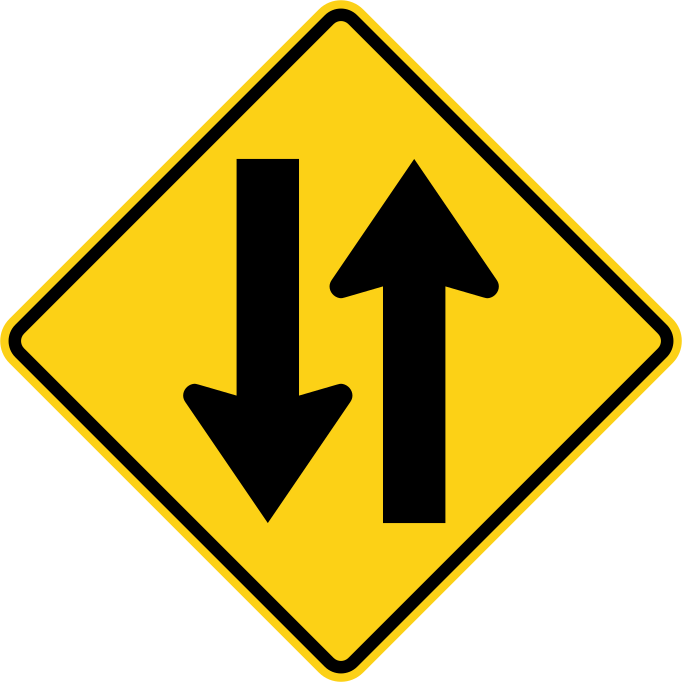
12. What does this Two-Way Traffic sign tell a driver about the road ahead?
- The one-way roadway changes to two-way traffic ahead. (correct)
- The right lane ends and traffic must merge left.
- A divided highway with a median begins ahead.
- A no-passing zone begins at this sign.
Why: The yellow diamond warns that a one-way roadway is changing to two-way traffic ahead, so you should stay right, hold off on passing, and watch for oncoming vehicles. The trap is the no-passing-zone reading: the entry does say do not pass at this sign, and a learner who fixates on that phrase reaches for the pennant-shaped no-passing zone sign instead of the warning that opposing traffic is about to appear.
Source: Manual on Uniform Traffic Control Devices, sign W6-3 (Two-Way Traffic).
-
13. What is one use of a solid white line on a Nevada roadway?
- Separates traffic lanes moving in opposite directions
- Marks the center of a two-way turn lane
- Marks the highway edge or a shoulder boundary (correct)
- Indicates an exit-only lane on the freeway
Why: Solid white lines do two related jobs. Between lanes moving the same direction, they mean do not change lanes or pass. At the edge of the roadway, they mark the boundary between the travel lane and the shoulder. Both uses come from the same rule set for white markings.
Source: Nevada Driver Manual, "Signs, Signals and Markings - Highway Markings," p.32.
-
14. A flashing red light at an intersection carries the same meaning as which type of sign?
- Yield sign
- Stop sign (correct)
- Warning sign
- Do not enter sign
Why: The manual describes flashing red directly: drivers must come to a full stop and may proceed only when the road is clear and they have the right-of-way. The manual states plainly that the signal has the same meaning as a stop sign. The other sign types listed do not require a mandatory full stop before proceeding.
Source: Nevada Driver Manual, "Signals," p.30.
-
15. What speed limit does the Nevada manual list for urban freeways and rural highways?
- 45 mph
- 55 mph
- 75 mph
- 65 mph (correct)
Why: The manual's speed-limit list ties 65 mph to two road types together: urban freeways and rural highways. It is easy to confuse this figure with the 45 mph reduced-speed-area figure below it or with the 70+ mph rural-interstate category above it. Rural interstate freeways sit in their own row.
Source: Nevada Driver Manual, "Controlling Speed," p.35.
-
16. Nevada bars a U-turn where a curve, hill, rain, or fog blocks your view. How far must you be able to see in each direction to make the turn legally?
- 500 feet
- 100 feet
- 200 feet (correct)
- 300 feet
Why: The general U-turn visibility rule bars the turn where a curve, hill, rain, fog, or other reason prevents the driver from seeing clearly 200 feet in each direction. A separate rule near a grade uses 500 feet. The trap here is mixing the two visibility distances.
Source: Nevada Driver Manual, "Signaling, Turning, Lane Changes, and Passing; U-Turns; Illegal U-Turns," p.46.
-
17. What must you do whenever you park and leave your vehicle in Nevada?
- Turn on the hazard lights while shutting the engine off.
- Turn off the engine and leave the transmission in neutral.
- Set the parking brake and leave the engine idling.
- Turn off the engine and set the parking brake. (correct)
Why: The Nevada manual gives a short checklist for every time you park and leave your vehicle: turn off the engine and set the parking brake. Both steps are required. The manual also warns separately that you must never turn the ignition to the lock position while the vehicle is still in motion, because doing so locks the steering. That warning is not a step in the parking routine; it is a hazard to avoid.
Source: Nevada Driver Manual, "Parking: general rules," p.48.
-
18. What is the minimum age to apply for a Nevada instruction permit?
- 18 years old
- 15½ years old (correct)
- 15 years old
- 16 years old
Why: Applicants must be at least 15½ years old to apply for a Nevada instruction permit, along with completing the application, passing vision and knowledge tests, and having a parent or guardian authorize issuance.
Source: Nevada Driver Manual, "Chapter 1 - Instruction Permits," p.15.
-
19. According to the Nevada manual, when must you file a Report of Crash (SR-1) with the DMV?
- Only after a crash that involves a fatality or serious bodily injury.
- Whenever a law enforcement officer investigates the crash at the scene.
- Within 24 hours of any crash, regardless of damage amount or whether an officer investigated.
- Within 10 days if no officer investigated and damages reach $750 or anyone was injured. (correct)
Why: When law enforcement does not investigate your crash, Nevada requires you to file a Report of Crash (SR-1) with the DMV within 10 days if the crash caused $750 or more in damages or any injury. The manual pairs three specifics: no officer on scene, the damage-or-injury threshold, and the 10-day deadline. When an officer does investigate, that officer sends the DMV your insurance information and a description of the damages, so the driver files nothing.
Source: Nevada Driver Manual, "Chapter 8: Insurance and Financial Responsibility," p.75.
-
20. What does this Food sign tell a driver about the road ahead?
- A restaurant or other place to eat is available ahead. (correct)
- A rest area with picnic tables lies ahead.
- Overnight lodging is offered near this exit.
- Fuel can be purchased at the next exit.
Why: The blue Food sign, a white fork and knife inside a circle, points to a restaurant or other place to eat off the highway ahead. The rest-area answer is the reach: a driver who groups every blue roadside services sign into a single 'rest stop' bucket picks it, without noticing the fork-and-knife icon that reserves this sign for dining.
Source: Manual on Uniform Traffic Control Devices, sign D9-8 (Food).
-
21. In an area where parallel parking is permitted, what is the minimum distance you must park from a fire hydrant?
- 25 feet.
- 10 feet.
- 15 feet. (correct)
- 20 feet.
Why: Nevada bans parking within 15 feet of a fire hydrant where parallel parking is permitted. Where angle parking is permitted, the clearance grows to 20 feet. Mixing up the two is the classic trap. Learners often half-remember the hydrant rule without knowing which distance goes with which parking format; anchor 15 feet to parallel and 20 feet to angle.
Source: Nevada Driver Manual, "Parking: No Parking Allowed," p.50.
-
22. The white word legend SCHOOL XING is painted in your travel lane. What does it warn you to do as you approach?
- Slow down, scan both sides for children, and be ready to stop for a pedestrian or crossing guard. (correct)
- Stop at the legend and wait for a crossing guard to wave you through.
- Reduce speed only after a child steps into the roadway ahead.
- Change into a non-adjacent lane before reaching the school property.
Why: The SCHOOL XING legend warns that a school crossing is just ahead. Slow down, scan both sides of the road for children, and be ready to stop for a pedestrian or crossing guard using the crosswalk. Drivers who wait until a child steps into the roadway are treating the marking as a reactive brake cue, when a legend printed ahead of the crossing exists to prepare you before anyone appears.
Source: Manual on Uniform Traffic Control Devices, marking 3B.21 (SCHOOL XING Pavement Legend).
-
23. What should a driver do when approaching this Slippery When Wet sign?
- Reduce speed and avoid sudden moves like hard braking. (correct)
- Come to a full stop before continuing onto the wet pavement.
- Pull off the roadway until the pavement fully dries.
- Turn on hazard lights and maintain the posted speed.
Why: The sign warns that the road surface ahead loses traction in rain, snow, or ice, so you ease off the accelerator, add following distance, and keep every input on the wheel and pedals gentle. The trap is the choice that calls for a full stop; a yellow warning diamond flags what to expect, and a driver who reaches for the stop-sign rule at every diamond is applying a regulatory response to a caution.
Source: Manual on Uniform Traffic Control Devices, sign W8-5 (Slippery When Wet).
-
24. You are in a Nevada crash with no police response, about $900 in property damage, and no injuries. How long do you have to send the SR-1 Report of Crash form to the DMV?
- No report is required because law enforcement did not investigate.
- You have 10 days from the crash to submit the SR-1. (correct)
- Your insurance company files the SR-1 with the DMV on your behalf.
- No report is required because no one was injured.
Why: When law enforcement does not investigate and the crash causes at least $750 in damage or any injury, Nevada requires the driver or registered owner to send the SR-1 to the DMV within 10 days. Skipping the filing can lead to suspension of your driver license or vehicle registration.
Source: Nevada Driver Manual, "Chapter 8 - Insurance and Financial Responsibility," p.75.
-
25. You see this yellow diamond sign on approach. What should you be prepared to do at the intersection ahead?
- Slow down and yield to vehicles already in the circle (correct)
- Come to a full stop before entering the circle
- Enter first because circle traffic must yield to you
- Continue at speed since the sign only marks the exit
Why: The yellow diamond warns of a roundabout ahead, so slow on approach and be ready to obey the entry yield control that gives priority to vehicles already circulating counterclockwise. Drivers carrying the four-way-stop habit into every intersection pick the full-stop answer, reading any yellow warning as a signed halt when the diamond only announces what is coming.
Source: Manual on Uniform Traffic Control Devices, sign W2-6 (Circular Intersection (Roundabout)).
Keep going.
Want explanations one question at a time? Browse every Nevada practice question or jump into the topic study guide.