Oregon Practice Test
A full-length practice test for the Oregon DMV knowledge test.
35 Questions Click an answer to reveal the explanation










Oregon Practice Test (35 questions). Correct answers and explanations are noted under each question.
-
1. Which of the following lets DMV waive the Oregon drive (behind-the-wheel) test?
- You surrendered an out-of-state license that expired more than one year ago.
- DMV has proof you completed an ODOT-Approved Driver Education Course within the past two years. (correct)
- You have completed 100 hours of supervised driving experience.
- You have held an Oregon instruction permit for at least six months.
Why: DMV may waive the drive test in only two situations: (1) you are a new resident surrendering an out-of-state license valid or expired less than one year, or (2) DMV receives proof you completed an ODOT-Approved Driver Education Course within the past two years. The other options confuse Oregon's under-18 Class C licensing prerequisites (permit-holding time and supervised driving hours) with waiver criteria, or invert the new-resident timing rule.
Source: Oregon Driver Manual, "Testing - Drive Test," p.3.
-
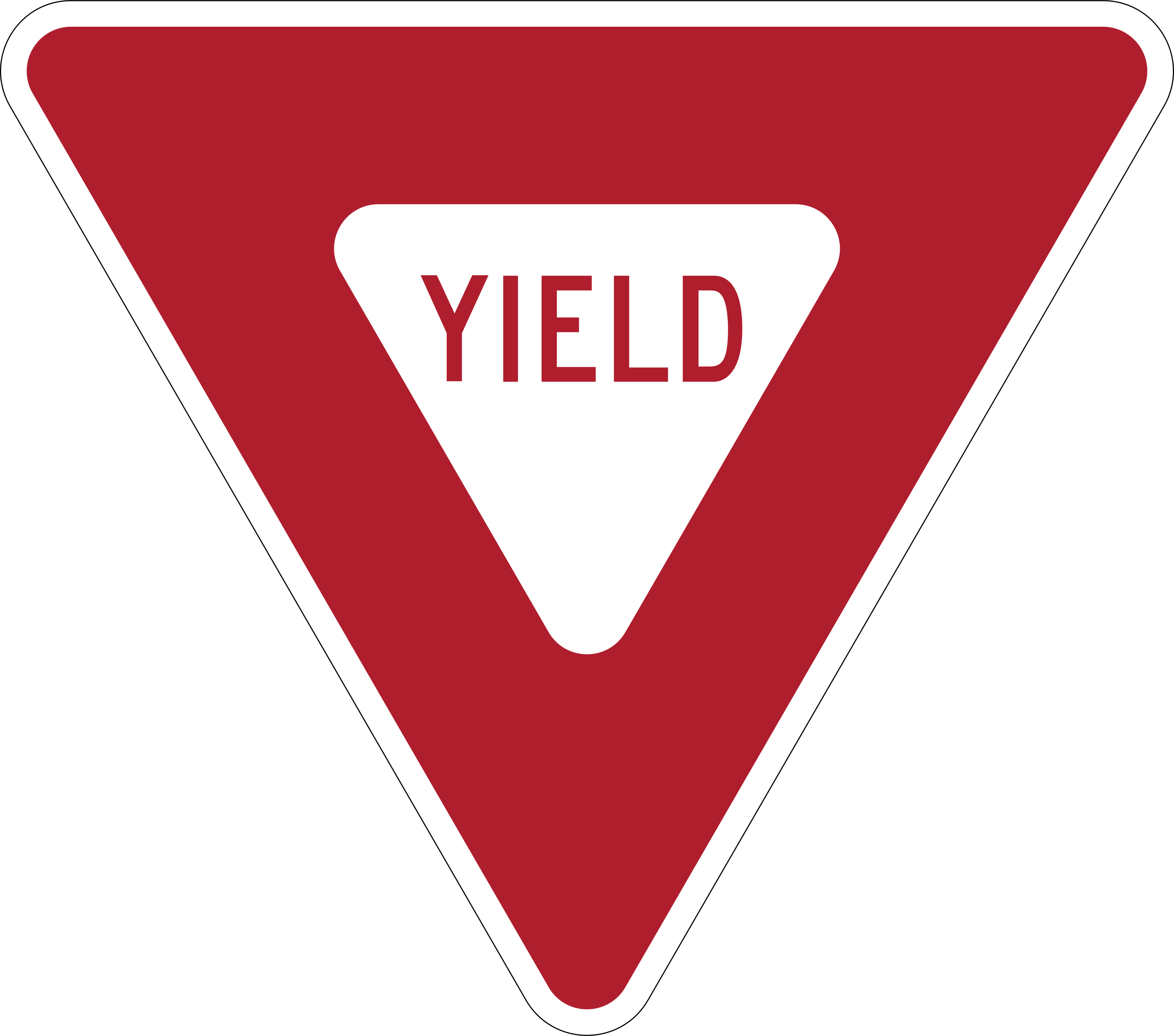
2. A yield sign requires you to do what?
- Stop fully and wait for a green signal.
- Reduce speed and yield right of way. (correct)
- Maintain your speed and merge with traffic.
- Always come to a complete stop, the same as for a stop sign.
Why: A yield sign tells you to slow down and give the right of way to other traffic and pedestrians. Stop only if doing so is necessary to yield safely. The triangle shape is your cue at a distance. A yield is not a stop sign, and treating every yield like a stop will hold up traffic behind you. Dropping the 'if needed' qualifier and treating every yield as a mandatory full stop is what pushes a driver to D.
Source: Oregon Driver Manual, "Signs & Traffic Signals, Regulatory Signs Prohibitive (Yield)," p.7.
-
3. What does this sign tell a driver about the road ahead?
- A campground for tent camping is available ahead. (correct)
- A roadside rest area is available ahead.
- A picnic area with tables is available ahead.
- A recreational vehicle sanitary dump station is ahead.
Why: A white tent on a blue square is a services sign that marks a campground for tent camping ahead. Drivers who pick the sanitary dump station reach for it because the reference entry lists dump stations as a related facility, but that is a separate device for a different service: this sign promises overnight tent sites.
Source: Manual on Uniform Traffic Control Devices, sign D9-3 (Camping).
-
4. You're outside city limits on a rural Oregon road and you want to make a U-turn. What visibility threshold must your vehicle satisfy?
- Visibility from both directions of at least a quarter mile.
- 500 feet of clear sight in each direction.
- Visibility of at least 100 feet.
- Visibility from both directions of at least 1,000 feet. (correct)
Why: Outside city limits, U-turns are prohibited where your vehicle cannot be seen by traffic from either direction within 1,000 feet, because rural speeds demand more sight distance for drivers to react to a car turning across the road. Inside city limits the sight-distance threshold drops to 500 feet, and a separate rule bars U-turns between intersections in a city. A driver picking B carries the inside-city 500-foot figure out onto a rural road, where the 1,000-foot rule governs instead.
Source: Oregon Driver Manual, "U-Turns," p.41.
-
5. Another driver behind you is starting to pass on a two-lane Oregon road. What's the right thing to do?
- Move onto the shoulder so the passer can use your lane.
- Speed up so the passer can't complete the pass.
- Stay right and adjust your speed to let them complete the pass. (correct)
- Flash your high beams to indicate the road ahead is clear.
Why: Stay to the right in your lane and adjust your speed so the passing driver can move back into the right lane safely as soon as possible. Do not use your hands or lights to signal the other driver when to pass; Oregon law specifically prohibits flashing any of your signals at drivers to let them know when to pass. The flash-your-highs habit behind D reads as courteous but is exactly the light-signal the manual forbids.
Source: Oregon Driver Manual, "Being Passed," p.33.
-
6. You experience a tire blowout while driving in Oregon. What's the correct response?
- Speed up to clear traffic before stopping.
- Turn the wheel sharply to compensate for the pull.
- Grip the wheel firmly, slow gradually, pull off. (correct)
- Brake hard and pull off immediately.
Why: Grip the steering wheel firmly, slow down gradually, then pull off the road. Hard braking on three good tires and one shredded one is destabilizing. A front blowout causes a strong pull to the side; a rear blowout causes the back to weave or sway. The grip-and-coast response keeps you on a straight path while losing speed. Answer D swaps the manual's gradual slowing for hard braking, the very input that sends a blown-tire vehicle into a swerve.
Source: Oregon Driver Manual, "Vehicle Equipment Failures > Blowouts," p.84.
-
7. You're approaching an Oregon roundabout. What's the entry rule?
- Accelerate to merge with circulating traffic at speed.
- Traffic entering the roundabout has the right of way over circulating traffic.
- Stop at the entry line, then merge into traffic.
- Yield to traffic inside and exiting the roundabout, then merge during a gap. (correct)
Why: Before entering a roundabout, you must yield to traffic already inside the circle as well as to traffic exiting it. Wait for a gap, then merge into the flow and continue counterclockwise to your exit. Oregon roundabouts are yield-controlled at entry, not stop-controlled. Choice C is the trap for drivers who treat a roundabout like a four-way stop; the entry is a yield, and you stop only when there is no gap or a pedestrian is in the crosswalk in your lane.
Source: Oregon Driver Manual, "Roundabouts," p.43.
-
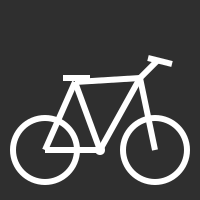
8. A white bicycle symbol painted on the pavement next to a solid white lane line marks the lane as what?
- A portion of the roadway set aside for the preferential use of bicyclists. (correct)
- A shared lane where cars and bikes have equal priority.
- A crossing point where bicyclists cut across traffic.
- A path reserved for bicycles only, closed to all motor vehicles at all times.
Why: The bike symbol paired with a solid white lane line marks the lane as reserved for the preferential use of bicyclists. The trap is the choice that stretches "preferential" into "exclusive," shutting every motor vehicle out at every hour; that overshoots the rule, because state and local traffic law spell out when other vehicles may enter or cross a bike lane.
Source: Manual on Uniform Traffic Control Devices, marking 9E.01 (Bicycle Lane Symbol).
-
9. A white right-turn arrow is painted in the lane you're driving in. What does it require?
- You must turn right at the next intersection. (correct)
- You may turn right or continue straight from the lane.
- You must yield to traffic before turning right.
- You must stop at the arrow before proceeding.
Why: A right-turn arrow painted in the lane makes that lane right-turn only, so any driver who enters it must turn right at the next intersection. The answer that also lets you continue straight is the trap for drivers who read the painted arrow as guidance to weigh against other movements, the way a shared-lane 'sharrow' marking works, rather than as a lane restriction that rules out every movement the arrow does not show.
Source: Manual on Uniform Traffic Control Devices, marking 3B.24 (Right-Turn Arrow).
-
10. You realize you have started to enter an Oregon freeway the wrong way. You should:
- Pull to the right shoulder, turn on your hazard lights, and stay near your vehicle until help arrives.
- Continue forward onto the freeway and exit at the next numbered exit.
- Speed up to clear the ramp and merge before oncoming vehicles arrive.
- Stop at the side of the ramp, turn on your hazard lights, then turn around or back off. (correct)
Why: If you start to enter a freeway the wrong way, a DO NOT ENTER or WRONG WAY sign will warn you of your mistake. Immediately pull off to the side of the ramp and stop, turn on your hazard lights to warn other vehicles, then cautiously turn around or back off the ramp. Choice B is the trap: drivers who borrow the "if you miss your exit, go to the next one" rule from Leaving a Freeway treat this as an exit-finding problem, but that rule assumes you are already going the right direction.
Source: Oregon Driver Manual, "Freeway Driving, Entering a Freeway," p.34.
-
11. You see this sign as one of a series posted along the outside of a curve. What does the series tell a driver?
- The direction and sharpness of the curve ahead. (correct)
- The end of a passing zone.
- The edge of the pavement where the shoulder drops off.
- The location of a driveway on the right side.
Why: A row of chevrons along the outside of a curve gives drivers a continuous visual indication of the curve's direction and sharpness, and each panel guides your eye through the bend as you slow down. The pavement-edge choice leans on the fact that the panels stand in a line along the shoulder, but chevrons face into the traffic to trace the curve itself, not to mark where the paved surface ends.
Source: Manual on Uniform Traffic Control Devices, sign W1-8R (Chevron Alignment (Right)).
-
12. A yellow center line has a solid line on your side and a broken line on the side used by oncoming traffic. What does this require of you?
- You are not allowed to pass another vehicle. (correct)
- You may pass when the way ahead is clear.
- Passing is allowed in either direction when safe.
- Passing is prohibited in both directions.
Why: Passing is decided by which line sits on your half of the road. A solid line on your side means passing is not allowed; the broken line belongs to oncoming traffic, and their permission does not extend to you. Drivers who pick the "when the way ahead is clear" option fall back on a rural rule of thumb that any open road allows passing, without first checking which line sits on their own side.
Source: Manual on Uniform Traffic Control Devices, marking 3B.02 (Broken-and-Solid Yellow Center Line).
-
13. A wide solid white line separates a freeway through lane from an exit ramp at the gore. What does it require of you?
- Settle into your lane before the line; crossing it is discouraged. (correct)
- Cross freely between the through lane and the ramp.
- Crossing is prohibited and can be ticketed.
- Traffic beyond the line is moving toward you.
Why: The wide solid white line at a ramp gore forms a neutral area between two paths of same-direction traffic. Settle into either the through lane or the ramp before you reach it, and stay out of the painted zone. The tempting wrong answer is the one that treats the solid white as a broken white lane line. A broken white line invites lane changes; a solid white channelizing line is drawn to hold you in the path you have already chosen, so drivers who are still deciding should decide sooner.
Source: Manual on Uniform Traffic Control Devices, marking 3B.08 (White Channelizing Line).
-
14. You're using an on-ramp to enter an Oregon freeway. What's the correct merging procedure?
- Stop at the end of the ramp and wait for a gap to merge.
- Speed up to match freeway traffic and yield to vehicles already on the freeway. (correct)
- Merge at your current speed; traffic already on the freeway must slow or change lanes to let you in.
- Drive on the shoulder until you find a gap.
Why: Use the on-ramp to speed up and match freeway traffic. You must yield to vehicles already on the freeway; they don't yield to you. Check your mirrors and blind spots, signal, and merge during a gap. Keep moving if possible: drivers behind you on the ramp expect you to speed up, not slow down. Stopping on a freeway on-ramp is dangerous unless a ramp meter requires it. The manual does tell freeway drivers to adjust their speed to permit a safe, smooth merge, but that instruction does not transfer the right of way; the legal duty to yield stays with the entering driver. Reading that courtesy as a duty binding freeway traffic is the trap in C.
Source: Oregon Driver Manual, "Entering a Freeway," p.34.
-
15. A single broken yellow line runs down the center of a two-way roadway. What does it permit a driver to do?
- Pass slower traffic by briefly crossing into the oncoming lane when the way is clear (correct)
- Make left turns from the center lane in either direction of travel
- Drive in the oncoming lane whenever traffic in the driver's own lane is heavy
- Straddle the line to share the roadway with wide oncoming vehicles
Why: A single broken yellow center line permits passing when the way is clear. A driver may briefly cross into the oncoming lane to pass slower traffic and then return. The trap is the answer that treats this line as a two-way left-turn lane; those lanes are marked with outer solid yellow lines paired with inner broken yellow lines, and a driver who learned that pattern first can reach for it here.
Source: Manual on Uniform Traffic Control Devices, marking 3B.01 (Broken Yellow Center Line).
-
16. You enter a work zone with a 35 mph posted limit. No workers or equipment are visible. How fast may you legally drive?
- The statutory default for the road
- The 35 mph work zone limit (correct)
- The speed of surrounding traffic
- The speed limit posted before the work zone
Why: The 35 mph work zone limit applies at all times the zone is in effect, and it holds until you see an End Work Zone Speed Limit sign or another posted speed sign. Drivers who pick D are half-remembering that a reduced work-zone limit only applies when workers are visible, so they mentally revert to the pre-zone speed the moment the scene looks empty.
Source: Oregon Driver Manual, "Work Zones," p.59.
-
17. What category of information do yellow diamond-shaped signs convey?
- Possible hazards or changes in road conditions ahead (correct)
- Required actions, such as stopping or yielding
- Routes, distances, and exit information
- Services available at the next exit
Why: Yellow diamond signs are warning signs; they alert you to a possible hazard or a change in road conditions ahead. Each sign category in Oregon pairs a distinct color with a shape, so confusing warning signs with regulatory, route, or service signs is a common error on this topic. Drivers who pick B are reaching for the category that commands an action such as stopping or yielding, but that job belongs to regulatory signs rather than to the yellow warning diamond.
Source: Oregon Driver Manual, "Warning Signs," p.10.
-
18. What color sign tells you a rest area is ahead?
- Yellow
- Brown
- Green
- Blue (correct)
Why: Rest areas are part of motorist services, so the sign is blue. The trap is treating a rest area as a recreational stop and reaching for brown. Rest areas, gas, food, lodging, and hospitals all share the blue motorist services category.
Source: Oregon Driver Manual, "Signs & Traffic Signals - Route, Guide, and Information Signs - Motorist Service Signs," p.14.
-
19. You're turning right across a marked bike lane at an Oregon intersection. A bicyclist is approaching in the bike lane. What must you do?
- Merge into the bike lane before the turn so the bicyclist passes you on the left.
- Turn first: bicycles must yield to motor vehicles.
- Yield to the bicyclist before turning across the bike lane. (correct)
- Stop in the bike lane and wait for the bicyclist to go around you.
Why: Drivers must yield to people riding bicycles in a bike lane or on a sidewalk before turning across the lane or sidewalk. You also may not move into or travel in a bike lane in preparation for a turn; you cross it at the turn itself, after yielding. Drivers used to merging into a dedicated right-turn lane before turning are the ones who pick A, treating a bike lane like the turn lane they know.
Source: Oregon Driver Manual, "Sharing the Road, Bicycles," p.50.
-
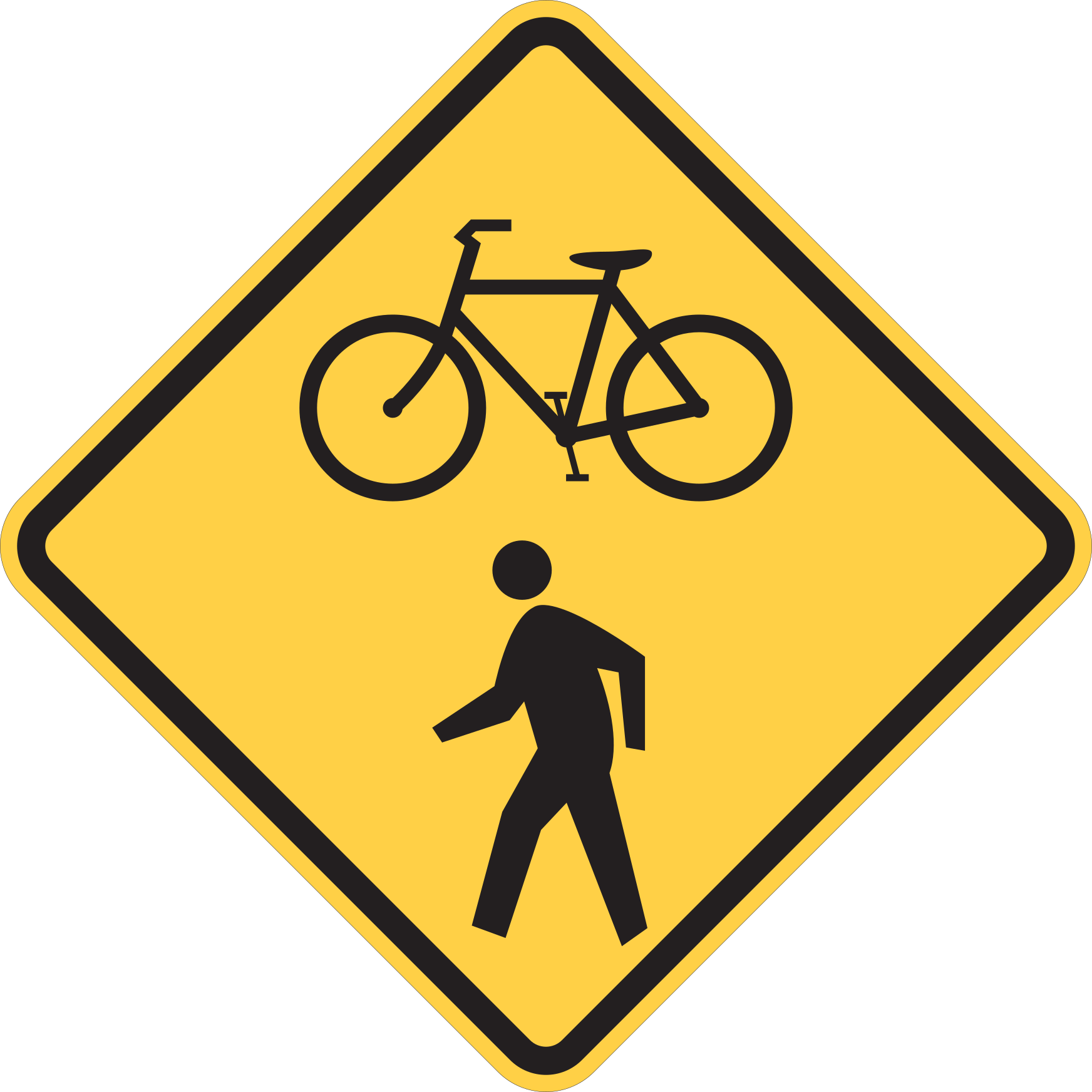
20. What does this warning sign tell a driver to expect on the road ahead?
- A shared crossing used by pedestrians and bicyclists (correct)
- A school crosswalk where children cross the road
- A bike lane beginning along the roadway
- A pedestrian-only crosswalk with no bikes
Why: The W11-15 warns of a shared crossing where pedestrians and bicyclists may enter the roadway, usually where a sidepath or multi-use trail meets the road at one point. The school-crosswalk reading is the trap because the S1-1 school crossing sign carries the same fluorescent yellow-green background, so the color reads to some drivers as 'children crossing' when it actually flags any non-motorist crossing.
Source: Manual on Uniform Traffic Control Devices, sign W11-15 (Pedestrian and Bicycle Crossing).
-
21. Two vehicles on crossing approaches arrive at an Oregon four-way stop at the same moment. Who has the right of way?
- The driver on the right. (correct)
- The driver on the left.
- The driver who came to a complete stop first.
- Whichever driver is going straight rather than turning.
Why: At a four-way stop, common courtesy is to let the driver who stops first go first, but that courtesy applies only when arrivals are staggered. For a true tie, the Oregon manual is explicit: "When in doubt, yield to the driver on your right." Direction of travel does not change who goes first. The trap is the first-to-stop courtesy; drivers stretch it past staggered arrivals when two vehicles feel close enough that each thinks they got there a hair sooner.
Source: Oregon Driver Manual, "Turns & Intersections," p.42.
-
22. What does this blue service sign with a white Rx symbol tell you?
- A pharmacy is available ahead. (correct)
- A hospital emergency department is ahead.
- A staffed first-aid station is ahead.
- A drugstore that stocks only over-the-counter remedies is ahead.
Why: The white Rx on a blue square is the federal services sign for a pharmacy, sitting in the same blue services family as the white H for a hospital and the knife-and-fork for a food service. Drivers who read 'drugstore' as an everyday synonym for pharmacy reach for the over-the-counter-only shop, forgetting that the Rx pictograph points at a prescription counter, not at any corner store stocking aspirin.
Source: Manual on Uniform Traffic Control Devices, sign D9-20 (Pharmacy).
-
23. A yellow diamond sign shows a vertical line with a smaller horizontal line extending to the right at a right angle. What does this sign warn of?
- A road merges into yours from the right
- The road ahead splits into two one-way roads
- A four-way intersection is ahead with cross-traffic
- A T-intersection ahead with side traffic (correct)
Why: The Side Road warning sign tells you a T-intersection is ahead, and traffic may enter from the left or right (the sign is mirrored to match which side the road joins from). Match the symbol to the geometry: a right-angle branch means a side road, a plus means a crossroad, and an angled join means a merge. Picking C swaps this T-intersection warning for the Crossroad sign with its plus symbol, but a four-way intersection with cross-traffic carries its own separate warning.
Source: Oregon Driver Manual, "Warning Signs," p.11.
-
24. At 60 mph in ideal conditions, the Oregon handbook says the total distance from when you recognize a hazard to when your vehicle stops is approximately what?
- About one car length per 10 mph.
- About 100 feet.
- More than 300 feet. (correct)
- About 50 feet.
Why: At 60 mph, the distance from the point you recognize a hazard and apply the brakes to where your vehicle stops is greater than the length of a football field, which is over 300 feet. The exact stopping distance depends on road and weather conditions, vehicle weight, reaction time, and brake quality, but the football-field benchmark is the handbook's shorthand for how much room you need at highway speeds. Answer D confuses reaction distance alone with the full hazard-recognition-to-stop figure the manual describes.
Source: Oregon Driver Manual, "Stopping Distances," p.29.
-
25. When driving past parked cars on an Oregon street, what does the handbook recommend?
- Cross into the next lane to give yourself the most room.
- Speed up past the parked cars to spend less time alongside them.
- Stay close to the parked cars to give the lane to your left.
- Move away from the parked cars within your lane. (correct)
Why: Keep extra space between your vehicle and parked cars by moving away from them without leaving your lane. A door may open in your path, or someone may step out from between parked vehicles. The cushion buys you time to react. Adjust your position within the lane instead of crossing the line. A is the trap for drivers who drop the 'without leaving your lane' qualifier and treat the cushion as a full lane change.
Source: Oregon Driver Manual, "Side Space Cushion," p.28.
-
26. An Oregon officer pulls you over and observes signs of impairment. Your breath test comes back at 0.06% BAC. Can you still be arrested for DUII?
- Yes, but only after you refuse a follow-up blood or urine test.
- No, an officer cannot arrest you for DUII unless your BAC reaches 0.08% or higher.
- Yes, 0.08% creates a presumption of impairment but is not a floor for arrest. (correct)
- No, Oregon law sets the minimum DUII arrest threshold at 0.05% BAC.
Why: Oregon's Impaired Driving section names 0.08% BAC as the level at which the law presumes impairment, but it explicitly states a driver can still be arrested with a BAC below that number when other evidence (driving behavior, field sobriety, officer observation) supports impairment. Test-takers who pick B are half-remembering 0.08% as an arrest threshold rather than the presumption threshold; the manual pairs the number with the phrase "you can still be arrested even if your BAC is lower than 0.08%."
Source: Oregon Driver Manual, "Impaired Driving," p.82.
-
27. An Oregon left-turn-only signal shows a steady green arrow pointing left. How does this change a left-turning driver's duty to yield to oncoming traffic, compared with a steady green circular light?
- Nothing changes; you still must yield to oncoming traffic under both signals.
- You have the right of way and do not yield to oncoming traffic. (correct)
- You must come to a complete stop before proceeding through the turn.
- Oncoming traffic also has a green signal, so you must still yield to it.
Why: A steady green arrow is a protected movement: the manual states you have the right of way and may make the indicated movement, and oncoming traffic is held by red. A steady green circular ('green ball') is permissive: a left-turning driver must still yield to oncoming traffic. Choice A is tempting because drivers taught 'always yield on a left turn' carry that habit over from the green ball and miss that the arrow is exactly what removes the yield duty.
Source: Oregon Driver Manual, "Traffic Signals," p.16.
-
28. Your vehicle has broken down on the shoulder of an Oregon highway. Visibility is limited and you cannot be seen from 200 feet in each direction. What does the handbook tell you to do?
- Place a single warning flag behind your vehicle, facing approaching traffic.
- Turn on your hazard lights and wait inside the vehicle until help arrives.
- Place flares at least 100 feet from your vehicle in each direction.
- Place flags, flares, signs, signals, or flaggers at least 200 feet from your vehicle in each direction. (correct)
Why: If your vehicle cannot be seen from 200 feet in each direction, warn approaching traffic with flags, flares, signs, signals, or flaggers placed at least 200 feet from your vehicle in each direction. Turn on your hazard lights as well. If you must leave the vehicle unattended, turn off the engine, remove the key, set the brakes, and leave the hazards on. The pull toward C comes from recalling a shorter placement distance and cutting the 200-foot requirement in half.
Source: Oregon Driver Manual, "Emergency Parking," p.71.
-
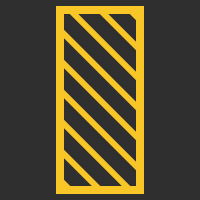
29. On the road ahead you see an area marked with yellow diagonal stripes. What does this area indicate?
- A two-way left turn lane.
- An off-limits area. (correct)
- A passing zone.
- A construction area.
Why: Yellow diagonal stripes within a painted median mark fixed objects ahead or areas where vehicle use is not allowed. It is illegal to drive in or make a turn across these stripes. Treat the striped area as off-limits to all vehicle movement. Drivers drawn to A confuse yellow diagonal stripes (off-limits painted median) with the two-way special left turn lane, another yellow-bordered center area but one they may legally enter to turn.
Source: Oregon Driver Manual, "Pavement Markings," p.23.
-
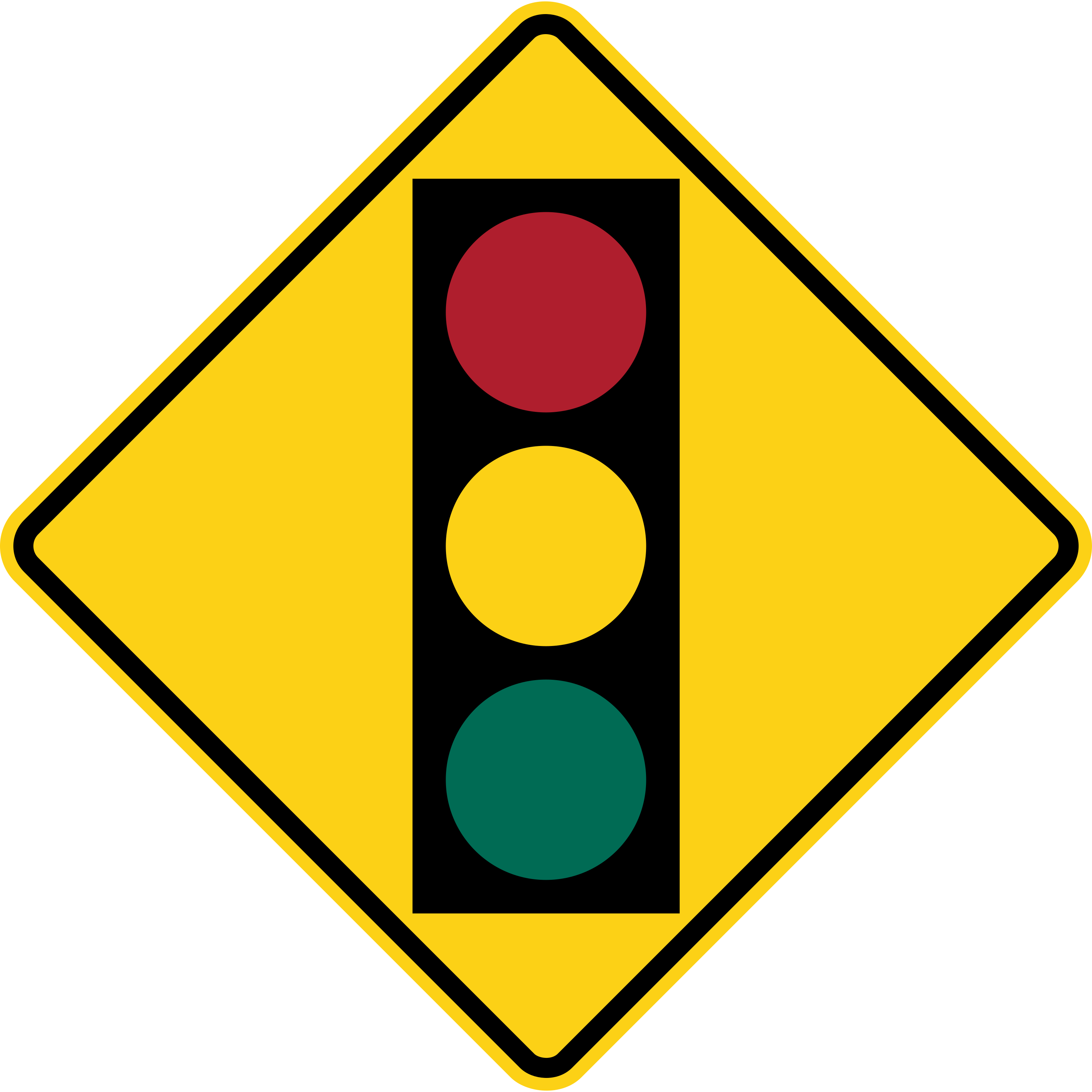
30. What does this warning sign tell a driver is ahead?
- A stop sign is ahead; prepare to come to a full stop before the sign.
- A traffic light is ahead; prepare to stop if the light is red or changes. (correct)
- A yield sign is ahead; prepare to slow and give way to cross traffic.
- A railroad crossing is ahead; prepare to stop for an approaching train.
Why: The Signal Ahead diamond warns that a traffic light is coming and calls for you to be ready to stop if the light is red or changes when you reach it. The trap is the answer that reads this as Stop Ahead. Stop Ahead is also a yellow diamond, but its interior symbol is a red octagon, not the signal head printed on the sign in front of you.
Source: Manual on Uniform Traffic Control Devices, sign W3-3 (Signal Ahead Symbol).
-
31. On Oregon roads, what color is used for pavement markings that separate traffic moving in opposite directions?
- Yellow on rural roads, with white used on urban roads in Oregon.
- White, with yellow used only inside posted no-passing zones.
- Yellow, including the center line on two-way roads. (correct)
- White, the same color used to mark the right edge of travel lanes.
Why: Yellow markings do two jobs on Oregon roads: they separate traffic moving in opposite directions (the center line), and they mark the left edge of one-way roads and ramps, two-way left turn lanes, and painted medians. White markings, by contrast, separate lanes going the same way and mark the right edge of travel lanes. Oregon follows the national standards, so the yellow/white rule holds on every road. D swaps the two colors, treating white as the centerline when the manual assigns that job to yellow.
Source: Oregon Driver Manual, "Pavement Markings," p.22.
-
32. What does this warning sign tell a driver about the road ahead?
- Two roads merge together and traffic from the right will enter your lane.
- A side road enters from the right ahead at roughly a right angle. (correct)
- The road ahead ends at a T-intersection where you must turn.
- Roads cross the main roadway from both sides ahead.
Why: The Side Road (Right) sign warns that a road joins the main roadway from the right ahead at roughly a right angle, so watch for vehicles entering or pulling out from that side road. The trap is the crossroad sign, which shows entering roads on both sides; a driver who glances at the diamond without noting that only the right arm is drawn reaches for the crossroad warning instead.
Source: Manual on Uniform Traffic Control Devices, sign W2-2R (Side Road (Right)).
-
33. You are driving an Oregon highway and see signs marked SAFETY CORRIDOR carrying diamond-shaped flags. What do those flags mark?
- A stretch with more fatal and serious crashes than average. (correct)
- A section where the speed limit changes without posted signs.
- A temporary work zone where fines are doubled.
- A detour route around a closed section of highway.
Why: Safety corridors are designated stretches of highway with more fatal and serious injury collisions than the statewide average, and the diamond-shaped flags call for you to turn your lights on for the length of the corridor. The work-zone answer tempts drivers who recall orange diamond flags from construction warning signs; safety-corridor flags look similar but mark crash history, not active roadwork.
Source: Oregon Driver Manual, "Route, Guide, and Information Signs (Safety Corridors)," p.13.
-
34. This pavement marking is painted across your lane at a stop-controlled intersection. Where must you bring your vehicle to a stop?
- Before any part of the vehicle crosses the line. (correct)
- With the front bumper directly over the line.
- At the curb of the cross street.
- Anywhere within one car length past the line.
Why: The stop line marks the exact boundary the vehicle must remain behind at a stop sign or red signal; the entry says to bring the front of the vehicle to a complete halt before any part of it crosses the line. The tempting wrong pick is stopping with the bumper directly over the line: drivers read the bar as a target to line up with rather than a boundary they may not cross, so they pull forward until the front wheel or bumper rests on the paint.
Source: Manual on Uniform Traffic Control Devices, marking 3B.16 (Stop Line).
-
35. You enter a ramp and see a large white arrow painted on the pavement pointing straight back toward your vehicle. What does this marking tell you?
- You are going the wrong way; stop and turn around when safe. (correct)
- The lane ahead ends and you must merge into the next lane.
- Continue in the direction the arrow points at the next intersection.
- The lane can carry traffic in either direction at certain hours.
Why: A white arrow aimed back at the driver marks the correct direction of traffic on a one-way road or exit ramp, so seeing the arrowhead means the vehicle has entered against the flow and must stop and turn around as soon as it is safe. The tempting wrong pick is the lane-ending reading, chosen by a driver used to reading every pavement arrow as a movement instruction; the lane-reduction arrow angles diagonally into an open lane rather than aiming straight back at the vehicle.
Source: Manual on Uniform Traffic Control Devices, marking 3B.24 (Wrong-Way Arrow).
Keep going.
Want explanations one question at a time? Browse every Oregon practice question or jump into the topic study guide. Ready to close the gaps for good? Own the Oregon book and its study system.