Pennsylvania Practice Test
A full-length practice test for the Pennsylvania PennDOT knowledge test.
18 Questions Click an answer to reveal the explanation




Pennsylvania Practice Test (18 questions). Correct answers and explanations are noted under each question.
-
1. A warning sign shows the main road curving left with a side road entering from the right. What specific hazard does the manual name?
- The side road is a no-outlet dead end
- Deer often cross where the two roads meet
- The pavement in the curve is especially slippery when wet
- Entering drivers may not see you around the curve (correct)
Why: The manual warns that a driver preparing to enter the main road may not be able to see you approaching from around the curve. B looks right to anyone defaulting to the DEER CROSSING warning shown on the next page, reading a rural-looking yellow diamond posted along a bend as a wildlife alert.
Source: Pennsylvania Driver Manual, "Warning Signs, Road Entering Curve," p.14.
-
2. A yellow diamond sign shows a truck tipping. What does the manual say this sign identifies?
- Curves where trucks at excessive speeds have a potential to rollover (correct)
- Steep grades where trucks should shift into a lower gear
- Weigh stations for commercial vehicles ahead
- Areas where trucks are prohibited from the roadway
Why: The manual says the truck rollover sign identifies curves where trucks traveling at excessive speeds have a potential to rollover. Learners often confuse it with the HILL/DOWNGRADE warning shown two entries later, which is the sign that actually tells drivers to shift to a lower gear on a steep grade.
Source: Pennsylvania Driver Manual, "Warning Signs - Truck Rollover," p.14.
-
3. You are driving on the interstate and see an approaching snow squall ahead. What does the manual tell you to do?
- Exit the roadway and wait for the squall to pass (correct)
- Speed up to get through the squall before visibility drops
- Stay in the left lane where snow accumulates more slowly
- Continue at highway speed with your hazard lights flashing
Why: Under its snow-squall guidance, the manual tells drivers to leave the road and wait the squall out rather than try to push through the sudden loss of visibility and traction. D scrambles the timing, borrowing hazard-light guidance meant for a squall you cannot avoid and applying it to one you can still get off the road ahead of.
Source: Pennsylvania Driver Manual, "Snow Squalls," p.42.
-
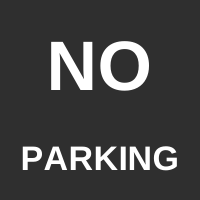
4. A white 'NO PARKING' legend is painted on the pavement along the curb ahead. What does it require of you?
- Park briefly if you leave your hazard lights on.
- Do not park a vehicle in that space. (correct)
- Park there outside posted business hours.
- The prohibition applies only during posted rush hours.
Why: The painted NO PARKING legend means you cannot park a vehicle in that space; treat it the same way you would a posted No Parking sign. The idea that flashing hazard lights buy you a quick stop is borrowed from delivery vans double-parking, and the painted word does not read blinkers.
Source: Manual on Uniform Traffic Control Devices, marking 3B.20 ("No Parking" Pavement Word Marking).
-
5. The manual prohibits parking within how many feet of a fire hydrant?
- 20 feet
- 25 feet
- 15 feet (correct)
- 10 feet
Why: Fire hydrants get a fifteen-foot exclusion zone so a hose crew can reach the hydrant without dragging equipment around a parked bumper. Learners often confuse this with the twenty-foot crosswalk rule or the thirty-foot stop-sign rule listed just above and below it in the same section.
Source: Pennsylvania Driver Manual, "Learning to Drive: Parking," p.53.
-
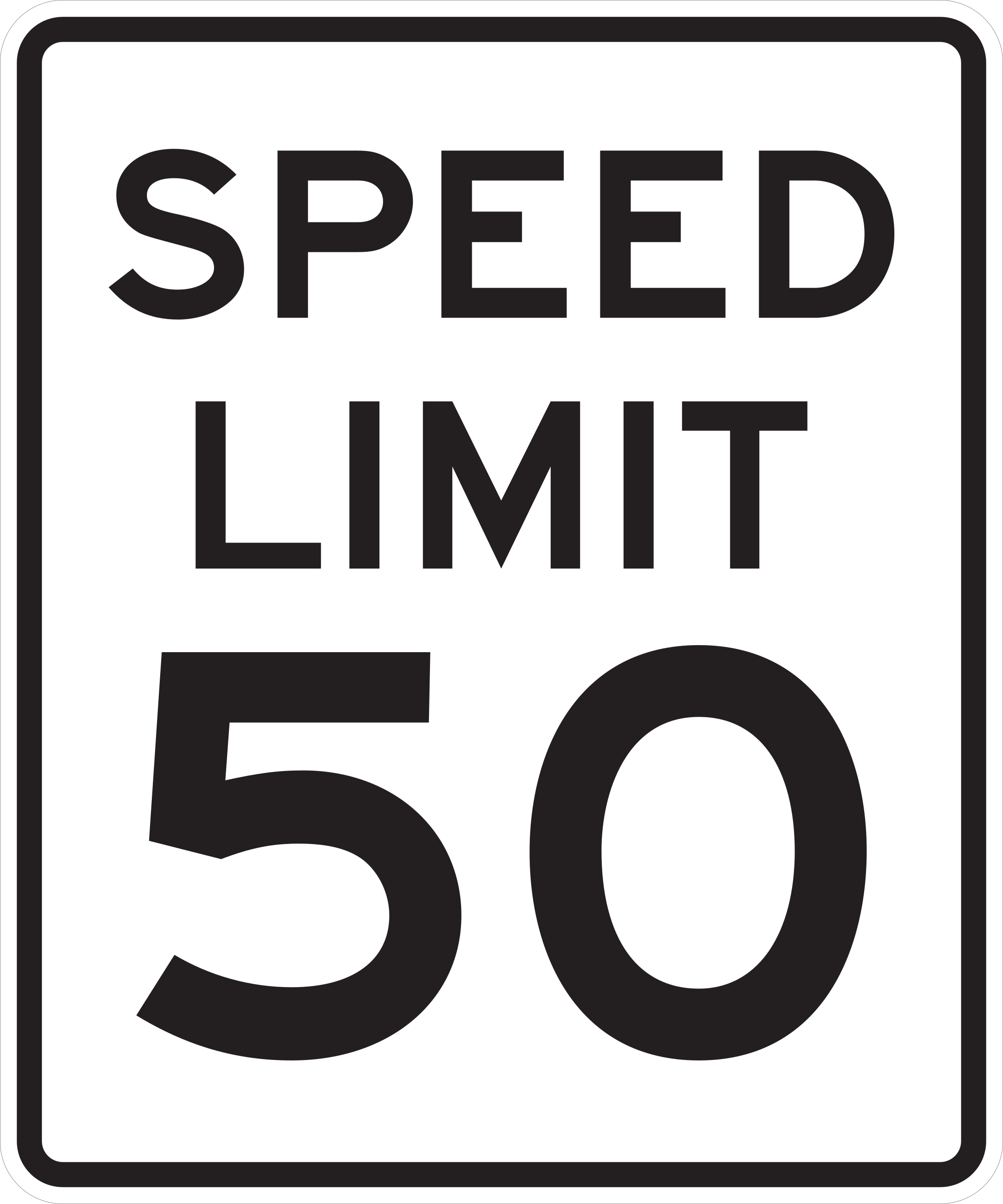
6. What does this Speed Limit 50 sign tell a driver about 50 mph on this roadway?
- 50 mph is the maximum legal speed on this roadway. (correct)
- 50 mph is the required minimum speed for through traffic here.
- 50 mph is an advisory speed for a curve or hazard ahead.
- Drivers should target 50 mph as the ideal cruising speed here.
Why: The sign posts the statutory maximum for the road ahead, so 50 mph is the ceiling, the highest speed a driver may legally travel until another speed limit sign changes it. Nothing on this sign requires driving 50 mph; it caps the speed rather than mandating it. Drivers who read the number as a required minimum are borrowing the look of a different white rectangle specifically labeled MINIMUM SPEED or MINIMUM SPEED LIMIT.
Source: Manual on Uniform Traffic Control Devices, sign R2-1 (Speed Limit 50).
-
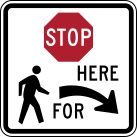
7. What does this Stop Here For Pedestrians sign require of a driver?
- Come to a complete stop for pedestrians at the marked crosswalk on the right. (correct)
- Yield to pedestrians and continue through the crosswalk if it is clear.
- Stop at the sign on every approach, whether or not a pedestrian is present.
- Slow down and watch for people who may cross the road ahead.
Why: The sign is a regulatory instruction to come to a full stop at the stop line for any pedestrian using the marked crosswalk on the right. The trap is the answer that treats it as an unconditional stop on every approach, which borrows the rule from the red octagonal stop sign; this device is triggered by a person in the crosswalk, not by arriving at the sign.
Source: Manual on Uniform Traffic Control Devices, sign R1-5bR (Stop Here For Pedestrians (Right)).
-
8. A wide solid white line separates a freeway through lane from an exit ramp at the gore. What does it require of you?
- Settle into your lane before the line; crossing it is discouraged. (correct)
- Cross freely between the through lane and the ramp.
- Crossing is prohibited and can be ticketed.
- Traffic beyond the line is moving toward you.
Why: The wide solid white line at a ramp gore forms a neutral area between two paths of same-direction traffic. Settle into either the through lane or the ramp before you reach it, and stay out of the painted zone. The tempting wrong answer is the one that treats the solid white as a broken white lane line. A broken white line invites lane changes; a solid white channelizing line is drawn to hold you in the path you have already chosen, so drivers who are still deciding should decide sooner.
Source: Manual on Uniform Traffic Control Devices, marking 3B.08 (White Channelizing Line).
-
9. You are 17 and received your learner's permit today. How soon may you take the Road Test?
- Six months after the permit issue date (correct)
- Immediately after logging the required hours
- As soon as a certified instructor signs off
- Whenever an appointment slot opens up
Why: Two conditions gate the Road Test for a driver under 18: a mandatory six-month wait from the permit issue date, and the signed certificate for the 65 hours. Finishing the hours early does not shorten the wait. The clock and the logbook run side by side.
Source: Pennsylvania Driver Manual, "Road Test and Special Point Examination Appointments," p.94.
-
10. What does this R15-6 sign require of a driver?
- Keep motor vehicles off the light rail or railroad tracks. (correct)
- Stop before crossing the tracks ahead.
- Yield the right of way to any approaching train.
- The lane is reserved for buses and rail vehicles only.
Why: The sign is a regulatory prohibition: motor vehicles may not travel on the light rail or railroad tracks that run beside the roadway. Drivers who read any track-related sign as a cue to stop reach for the stop-before-crossing answer, importing the rule that belongs to a crossbuck or an octagonal stop sign at the crossing itself.
Source: Manual on Uniform Traffic Control Devices, sign R15-6 (No Motor Vehicles On Tracks).
-
11. The manual lists three steps to merge with traffic from an acceleration lane. What is the first step?
- Flash your headlights to warn drivers already on the highway.
- Signal and look for an opening in traffic. (correct)
- Accelerate to the speed of the highway traffic.
- Stop at the end of the ramp and wait for a large gap.
Why: Step one puts your turn signal on and picks the opening in traffic; accelerating up to traffic speed is step two, and the actual merge is step three. Choice C swaps the first two steps, tempting drivers who read the lane's name and assume speed-matching is the opener.
Source: Pennsylvania Driver Manual, "MERGING WITH TRAFFIC," p.46.
-
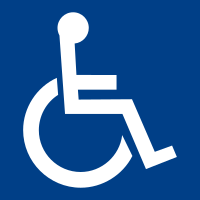
12. The blue wheelchair symbol painted on a parking space marks the space as what?
- Reserved for vehicles displaying a valid disability placard or plate. (correct)
- Free parking closest to the entrance for any driver in a hurry.
- Reserved for medical staff and emergency responders on duty.
- Loading zone for wheelchair-accessible vans during business hours.
Why: A parking space marked with the wheelchair symbol is reserved for vehicles displaying a valid disability placard or license plate. The trap is the answer that treats the symbol as a convenience marker for the closest spot to the entrance; these spaces are often near the door, but proximity is not what the paint reserves. Access for a placard or plate holder is.
Source: Manual on Uniform Traffic Control Devices, marking 3B.27 (Accessible Parking Symbol).
-
13. What should a driver understand from this Curve Right sign?
- Slow before the rightward curve and keep to your lane. (correct)
- Stop at the curve and yield to oncoming traffic before entering.
- Make a sharp right turn at the intersection ahead.
- Merge left because the right lane ends ahead.
Why: This is a warning of a rightward curve, so be ready to slow before the bend as the road calls for and hold your lane through it. Drivers who read a yellow warning diamond as though it carried the regulatory force of a red-and-white sign, expecting it to command a stop or yield, are the ones drawn to the stop-and-yield answer.
Source: Manual on Uniform Traffic Control Devices, sign W1-2R (Curve Right).
-
14. A broken white line separates your lane from the lane to your left, both traveling in the same direction. What does this marking permit?
- Lane changes across the line when it is safe to do so. (correct)
- Passing by crossing into oncoming traffic.
- Crossing only in an emergency.
- Nothing; the line must not be crossed.
Why: A broken white line divides lanes moving the same way, and a driver may cross it to change lanes whenever the move is safe: signal, check mirrors and blind spots, then move over. The choice about passing into oncoming traffic reaches for the rule that governs broken yellow center lines on two-way roadways; broken white never sits between opposing lanes and has nothing to do with oncoming vehicles.
Source: Manual on Uniform Traffic Control Devices, marking 3B.04 (Broken White Lane Line).
-
15. The manual says most crashes between vehicles and motorcycles happen at intersections. What action does it name as the usual cause?
- A motorcycle passing a vehicle on the right at a green light.
- A vehicle rear-ending a motorcycle stopped at a red light.
- A motorcycle drifting into a vehicle's blind spot on a highway.
- A vehicle turning left in front of a motorcycle going straight. (correct)
Why: The manual identifies the classic intersection crash: a driver turning left in front of a moving motorcycle after failing to yield. Rear-end and blind-spot crashes are real risks in other settings, but they are not the intersection pattern the manual names. Answer C carries the highway No-Zone risk into an intersection where the danger it names is a driver turning across the motorcycle's path.
Source: Pennsylvania Driver Manual, "Sharing the Road With Pedestrians, Bicyclists, and Motorcyclists and Moped Drivers - Motorcyclists and Moped Drivers," p.56.
-
16. The manual describes the 'Dutch Reach' method for opening a vehicle door. What does the method involve?
- Opening the door with the hand farther from the door. (correct)
- Opening the door with two hands to control its swing.
- Opening the door only after both mirrors show empty roadway.
- Opening the door no more than halfway on the first push.
Why: Open the door with the hand farther from it (a driver uses the right hand, a passenger the left). Reaching across turns your body toward the door and gives a much wider view of approaching bicyclists. B fixes on hand count instead of hand choice, folding a generic two-hand door-control habit into a technique that is actually defined by which hand does the reaching.
Source: Pennsylvania Driver Manual, "The Danger of Open Doors to Bicyclists," p.93.
-
17. According to the manual, how much longer does it usually take to pass a truck than a car on a level highway?
- About fifteen seconds more.
- Roughly one full minute more.
- Only three to five seconds more. (correct)
- Between eight and ten seconds more.
Why: The manual gives a narrow, specific window: three to five seconds longer than passing a car on a level road. On upgrades and downgrades the picture changes, but the level-highway figure is the one to memorize. B stretches a vague memory that passing trucks takes a long time into a full minute rather than settling on the level-highway three-to-five-second figure.
Source: Pennsylvania Driver Manual, "Sharing the Road With Trucks and Buses - Passing a Truck," p.56.
-
18. According to the manual, roughly what share of police-reported traffic crashes are caused by driver distraction and inattention?
- 15 to 20 percent
- 45 to 50 percent
- 5 to 10 percent
- 25 to 30 percent (correct)
Why: The manual attributes 25 to 30 percent of police-reported crashes to distraction and inattention. Pick A and you are leaning on a rough 'one in five' rule of thumb that gets applied to various crash-cause statistics.
Source: Pennsylvania Driver Manual, "Chapter 3: Learning to Drive, Driver Factors (Inattention)," p.32.
Keep going.
Want explanations one question at a time? Browse every Pennsylvania practice question or jump into the topic study guide. Ready to close the gaps for good? Own the Pennsylvania book and its study system.