South Carolina Practice Test
A full-length practice test for the South Carolina DMV knowledge test.
25 Questions Click an answer to reveal the explanation











South Carolina Practice Test (25 questions). Correct answers and explanations are noted under each question.
-
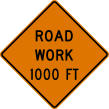
1. What should a driver do when approaching this Road Work Ahead sign?
- Slow down and watch for workers, equipment, and changed lanes. (correct)
- Stop at the sign and wait for a flagger before proceeding.
- Merge left because the right lane closes at the sign.
- Take the marked detour beginning at the sign.
Why: This advance warning sign tells you there's road work ahead, so slow down and watch for workers, equipment, and changed lanes. The merge answer comes from treating this general work-zone warning as the arrowed lane-closure sign that follows it further along the approach only when a lane actually drops.
Source: Manual on Uniform Traffic Control Devices, sign W20-1 (Road Work Ahead).
-
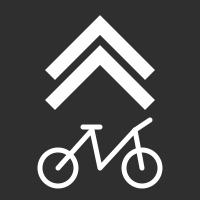
2. A bicycle symbol topped by two white chevron arrows is painted in the middle of a travel lane. What does this marking tell a driver?
- Bicyclists share the lane with cars; expect bikes and pass with care. (correct)
- The lane is reserved for bicycles and closed to motor vehicles.
- Bicyclists must ride to the far right edge of the lane at all times.
- A bike route crosses the road ahead, so watch for cyclists from the side.
Why: A sharrow tells drivers that bicyclists share the same travel lane. Pass only when you can give the rider a safe buffer, and change lanes if the lane is too narrow to share side by side. A bike lane is a separate bicycle space marked by lane lines; a sharrow sits in a general travel lane that bikes and cars share. The bike-only reading is the trap for drivers who spot the painted bike symbol and skip past the chevrons on top that mark the lane as shared.
Source: Manual on Uniform Traffic Control Devices, marking 3C.04 (Shared-Lane Marking (Sharrow)).
-
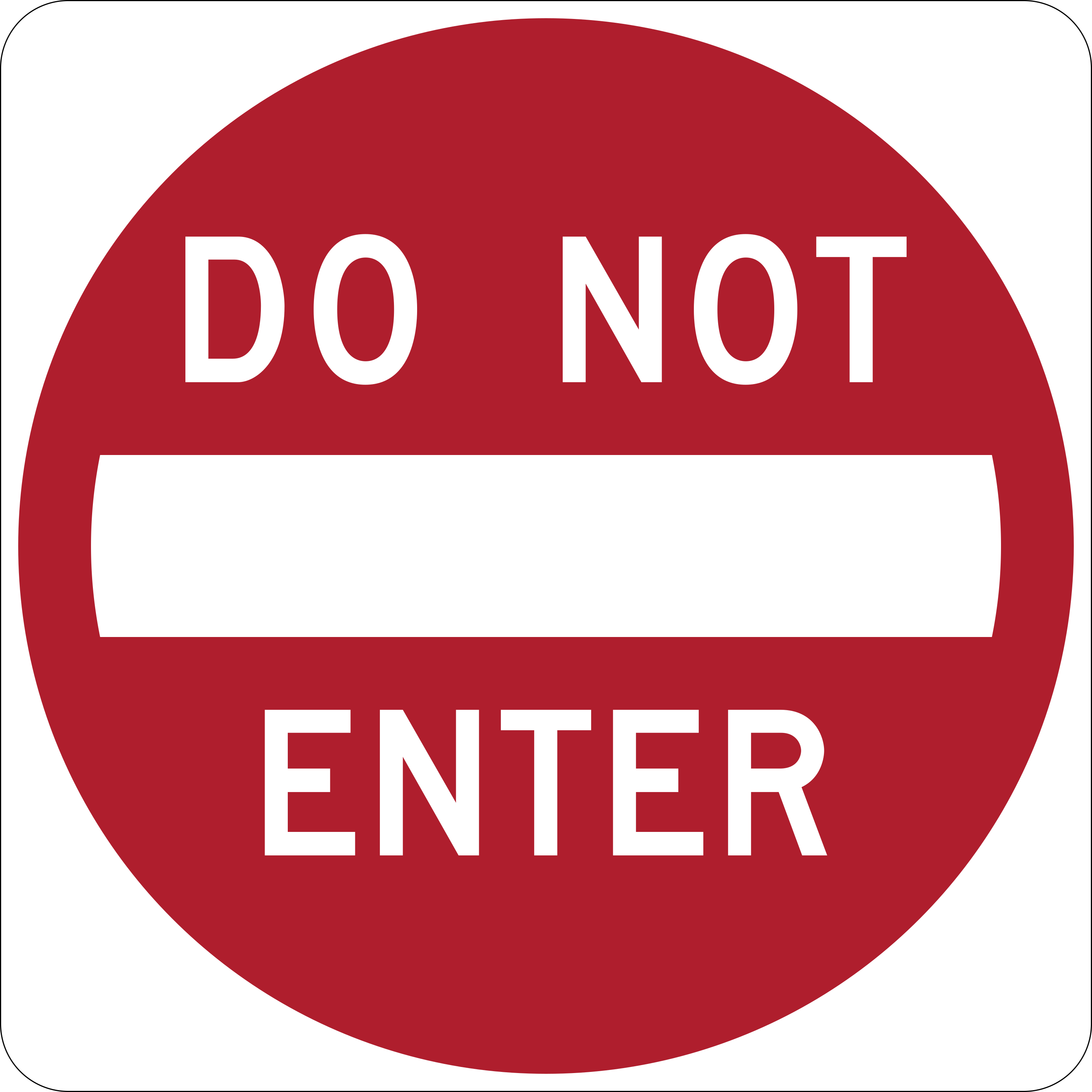
3. What does this Do Not Enter sign require of a driver facing it?
- Do not enter the roadway from this direction. (correct)
- Yield to oncoming traffic, then enter with caution.
- Enter only if you are a local resident or delivery driver.
- Enter only if driving a passenger car, not a truck.
Why: The sign bars entry from your direction because the roadway ahead is one-way against you or is a restricted entrance; stop, back out safely, or turn around. The tempting wrong answer treats the red square like a yield, telling the driver to pause, look for oncoming, and then go if it looks clear. Yielding does not solve the problem the sign describes: any traffic on the roadway ahead is coming toward you because the roadway only runs the other way.
Source: Manual on Uniform Traffic Control Devices, sign R5-1 (Do Not Enter).
-
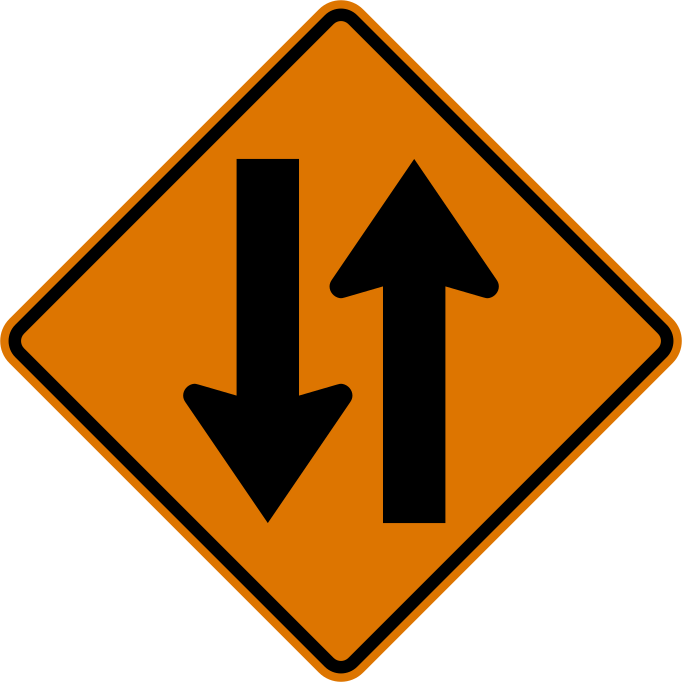
4. What does this orange diamond sign warn of ahead?
- Two-way traffic shares the roadway ahead through the construction area. (correct)
- Your lane ends ahead and traffic must merge to the left.
- A detour begins ahead and directs traffic off the roadway.
- Passing is prohibited through the construction zone ahead.
Why: The orange diamond warns that through the construction area the roadway carries vehicles in both directions, so oncoming traffic will share the same pavement and a driver has to stay right of the centerline. The no-passing answer is the pull here because two-way work zones often do restrict passing, and a learner who has driven through one associates the two ideas; this sign warns of the two-way condition itself, and a separate device carries any passing prohibition.
Source: Manual on Uniform Traffic Control Devices, sign CW6-3 (Two-Way Traffic (Work Zone)).
-
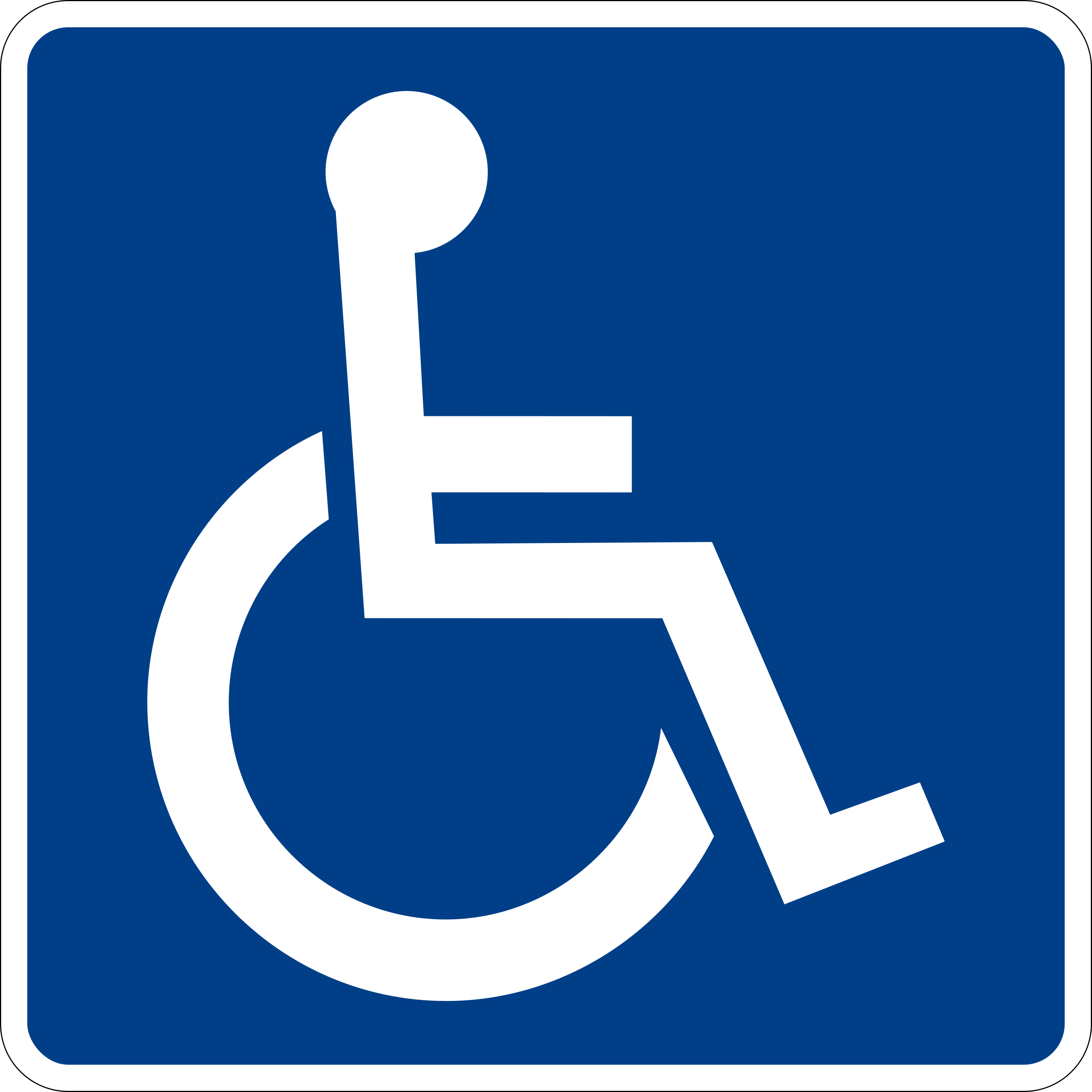
5. The blue wheelchair symbol painted on a parking space marks the space as what?
- Reserved for vehicles displaying a valid disability placard or plate. (correct)
- Free parking closest to the entrance for any driver in a hurry.
- Reserved for medical staff and emergency responders on duty.
- Loading zone for wheelchair-accessible vans during business hours.
Why: A parking space marked with the wheelchair symbol is reserved for vehicles displaying a valid disability placard or license plate. The trap is the answer that treats the symbol as a convenience marker for the closest spot to the entrance; these spaces are often near the door, but proximity is not what the paint reserves. Access for a placard or plate holder is.
Source: Manual on Uniform Traffic Control Devices, marking 3B.27 (Accessible Parking Symbol).
-
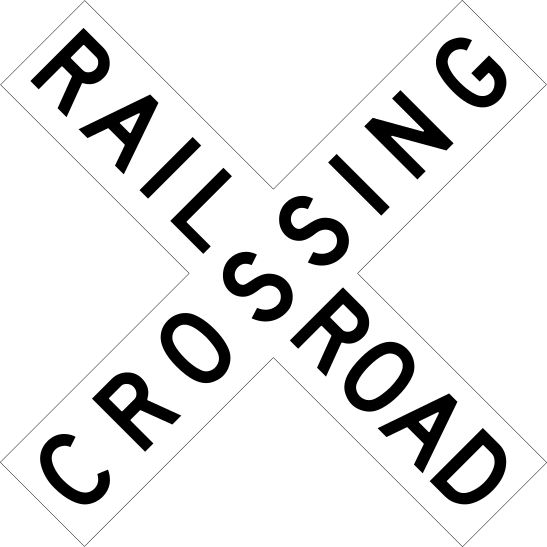
6. What does this crossbuck sign require of a driver approaching the tracks?
- Yield to any approaching train and cross only when the tracks are clear. (correct)
- Come to a complete stop before every crossing, whether or not a train is approaching.
- Proceed without slowing because the crossbuck only marks the location of the tracks.
- Yield to cross traffic on the road that intersects at this location.
Why: The crossbuck acts as a yield device at a highway-rail grade crossing: slow down, look and listen both ways, and cross only when no train is coming. The trap is the answer that treats every crossing as a mandatory stop, which carries a stop-sign habit over to a device that only demands a stop when a train is actually there.
Source: Manual on Uniform Traffic Control Devices, sign R15-1 (Railroad Crossing (Crossbuck)).
-
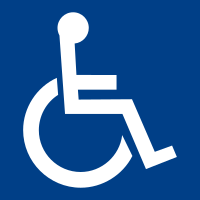
7. A white wheelchair symbol on a blue square is posted on a sign ahead of you. What does it tell a driver?
- The facility or parking space ahead is accessible to people with disabilities. (correct)
- A hospital is located ahead at the next exit.
- First aid or emergency medical services are available ahead.
- Pedestrians with limited mobility may be crossing the road ahead.
Why: A white wheelchair on a blue square is the International Symbol of Accessibility, and it tells you the facility or parking space ahead is accessible to people with disabilities. If you treat every blue services sign as medical, you pick the hospital answer instead. Hospitals carry a white H, not a wheelchair.
Source: Manual on Uniform Traffic Control Devices, sign D9-6 (International Symbol of Accessibility).
-
8. You see this yellow diamond sign on approach. What should you be prepared to do at the intersection ahead?
- Slow down and yield to vehicles already in the circle (correct)
- Come to a full stop before entering the circle
- Enter first because circle traffic must yield to you
- Continue at speed since the sign only marks the exit
Why: The yellow diamond warns of a roundabout ahead, so slow on approach and be ready to obey the entry yield control that gives priority to vehicles already circulating counterclockwise. Drivers carrying the four-way-stop habit into every intersection pick the full-stop answer, reading any yellow warning as a signed halt when the diamond only announces what is coming.
Source: Manual on Uniform Traffic Control Devices, sign W2-6 (Circular Intersection (Roundabout)).
-
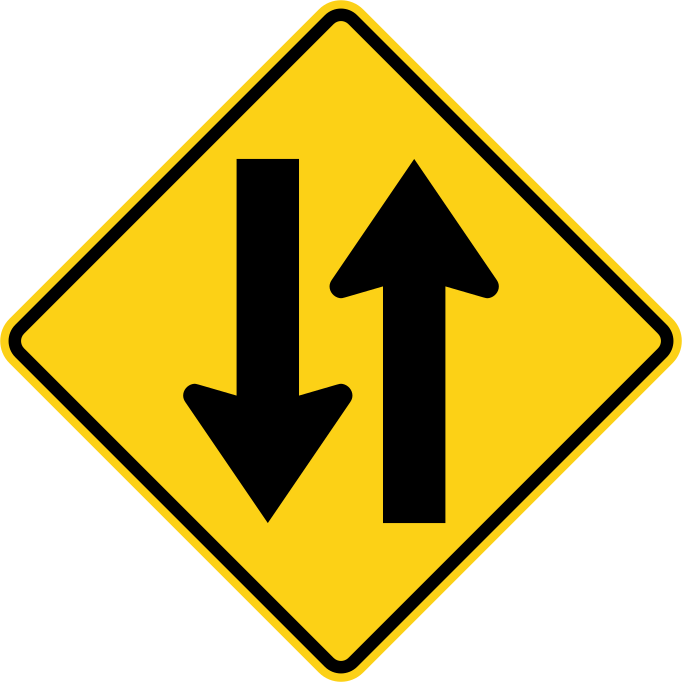
9. What does this Two-Way Traffic sign tell a driver about the road ahead?
- The one-way roadway changes to two-way traffic ahead. (correct)
- The right lane ends and traffic must merge left.
- A divided highway with a median begins ahead.
- A no-passing zone begins at this sign.
Why: The yellow diamond warns that a one-way roadway is changing to two-way traffic ahead, so you should stay right, hold off on passing, and watch for oncoming vehicles. The trap is the no-passing-zone reading: the entry does say do not pass at this sign, and a learner who fixates on that phrase reaches for the pennant-shaped no-passing zone sign instead of the warning that opposing traffic is about to appear.
Source: Manual on Uniform Traffic Control Devices, sign W6-3 (Two-Way Traffic).
-
10. The white word legend SCHOOL XING is painted in your travel lane. What does it warn you to do as you approach?
- Slow down, scan both sides for children, and be ready to stop for a pedestrian or crossing guard. (correct)
- Stop at the legend and wait for a crossing guard to wave you through.
- Reduce speed only after a child steps into the roadway ahead.
- Change into a non-adjacent lane before reaching the school property.
Why: The SCHOOL XING legend warns that a school crossing is just ahead. Slow down, scan both sides of the road for children, and be ready to stop for a pedestrian or crossing guard using the crosswalk. Drivers who wait until a child steps into the roadway are treating the marking as a reactive brake cue, when a legend printed ahead of the crossing exists to prepare you before anyone appears.
Source: Manual on Uniform Traffic Control Devices, marking 3B.21 (SCHOOL XING Pavement Legend).
-
11. What does this advance warning sign tell a driver about the road ahead?
- Railroad tracks cross ahead; slow down and be ready to stop for a train. (correct)
- Railroad tracks are at this location; yield to any approaching train.
- A traffic light is ahead where the driver may need to stop.
- A school crossing is ahead with children who may be crossing.
Why: The round yellow disc is the advance warning that railroad tracks cross the road ahead, so you slow down, look both ways, and be ready to stop for a train. The trap is the choice that treats this sign as the crossbuck posted at the tracks themselves; the crossbuck is white and X-shaped, while this round yellow sign sits back from the crossing to warn a driver in time to slow.
Source: Manual on Uniform Traffic Control Devices, sign W10-1 (Highway-Rail Grade Crossing (Round Advance Warning)).
-
12. What does this R15-6 sign require of a driver?
- Keep motor vehicles off the light rail or railroad tracks. (correct)
- Stop before crossing the tracks ahead.
- Yield the right of way to any approaching train.
- The lane is reserved for buses and rail vehicles only.
Why: The sign is a regulatory prohibition: motor vehicles may not travel on the light rail or railroad tracks that run beside the roadway. Drivers who read any track-related sign as a cue to stop reach for the stop-before-crossing answer, importing the rule that belongs to a crossbuck or an octagonal stop sign at the crossing itself.
Source: Manual on Uniform Traffic Control Devices, sign R15-6 (No Motor Vehicles On Tracks).
-
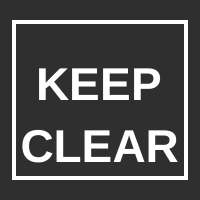
13. Traffic on the far side of the intersection has stopped as you reach a white KEEP CLEAR legend painted across your lane. What does the marking require of you?
- Wait behind the marking until you can get across without stopping in it. (correct)
- Stop inside the marked area to hold your position in the traffic queue.
- Pull forward into the marked area to leave the intersection behind you clear.
- Enter the marked area only after the cross-street signal turns red.
Why: The KEEP CLEAR legend holds the marked area open for cross traffic and vehicles entering the intersection, so when the road ahead is stopped and you cannot clear the marking you wait behind it. The trap is the choice that stops inside the box; a driver who sees painted words on the road defaults to reading them as a stop line, because that is how most pavement legends work, but this one marks the exact place the driver must not stop.
Source: Manual on Uniform Traffic Control Devices, marking 3B.26 (KEEP CLEAR Pavement Legend).
-
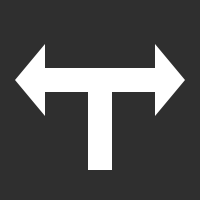
14. A lane is marked on the pavement with a white arrow that points both left and right. What does this require of a driver in that lane?
- Turn left or turn right; going straight is not allowed. (correct)
- Turn left only, since the left arrow has priority.
- Continue straight or turn, based on traffic conditions.
- Yield to oncoming traffic before choosing a direction.
Why: A two-headed arrow marks a mandatory-turn lane: a driver in that lane must go left or right, and continuing straight is not permitted. The trap is the option that keeps straight on the table as a traffic-dependent choice, which is how a shared through-and-turn lane works. This marking is not shared. The lane is dedicated to turning, and the through movement has been ruled out before the stop bar.
Source: Manual on Uniform Traffic Control Devices, marking 3B.24 (Left-or-Right Turn Arrow).
-
15. What should a driver do when approaching this Slippery When Wet sign?
- Reduce speed and avoid sudden moves like hard braking. (correct)
- Come to a full stop before continuing onto the wet pavement.
- Pull off the roadway until the pavement fully dries.
- Turn on hazard lights and maintain the posted speed.
Why: The sign warns that the road surface ahead loses traction in rain, snow, or ice, so you ease off the accelerator, add following distance, and keep every input on the wheel and pedals gentle. The trap is the choice that calls for a full stop; a yellow warning diamond flags what to expect, and a driver who reaches for the stop-sign rule at every diamond is applying a regulatory response to a caution.
Source: Manual on Uniform Traffic Control Devices, sign W8-5 (Slippery When Wet).
-
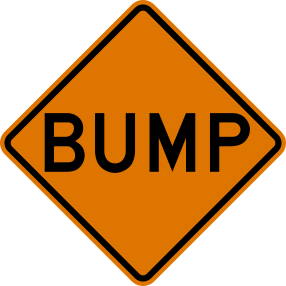
16. This orange diamond sign warns of a bump in a work zone. What should you do?
- Slow down before reaching the bump. (correct)
- Come to a complete stop before the patched pavement.
- Change lanes to avoid the raised pavement.
- Maintain speed to cross the bump smoothly.
Why: The sign warns that a short, abrupt rise lies ahead in the construction area, and the safest response is to slow down before you reach it so the vehicle stays stable and cargo, suspension, and following traffic aren't jolted. Drivers who trust the road habit that a bit of momentum floats a small bump, and so try to hold speed to cross it smoothly, are the ones who miss the sign's slow-down instruction.
Source: Manual on Uniform Traffic Control Devices, sign CW8-1 (Bump (Work Zone)).
-
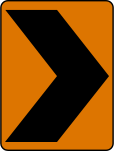
17. You approach this orange chevron sign posted through a work zone. What does it require of you as a driver?
- Reduce speed and follow the chevrons through the curve as the road bends right. (correct)
- Merge to the left because the right lane ends ahead in the work zone.
- Stop completely before entering the curve and wait for a flagger.
- Do not pass because a hill or curve limits the sight distance ahead.
Why: The orange chevron is an alignment marker on the outside of a rightward curve in a work zone, so slow down and steer along the chevrons while watching for shifted lanes, barriers, or workers. The lane-ends reading pulls in drivers who treat any orange rectangle in a work zone as a merge warning, but this device shows the shape of the road, not the loss of a lane.
Source: Manual on Uniform Traffic Control Devices, sign CW1-8R (Chevron Alignment Right (Work Zone)).
-
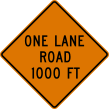
18. What does this orange diamond warning sign tell you about the road ahead?
- One lane about 1,000 feet ahead shared by traffic in both directions. (correct)
- Two lanes merge into one in your direction of travel ahead.
- The road is closed to through traffic 1,000 feet ahead.
- A one-way street begins 1,000 feet ahead.
Why: The sign warns that about 1,000 feet ahead the road narrows to one lane that both directions of traffic must share, so you slow down and prepare to yield to oncoming vehicles or a flagger. The trap is the choice that reads it as a lane-drop merge; a merge sign shows two same-direction lanes joining into one, while this sign specifically warns of two-way traffic sharing a single lane.
Source: Manual on Uniform Traffic Control Devices, sign CW20-4 (One Lane Road 1000 Ft).
-
19. What does this Food sign tell a driver about the road ahead?
- A restaurant or other place to eat is available ahead. (correct)
- A rest area with picnic tables lies ahead.
- Overnight lodging is offered near this exit.
- Fuel can be purchased at the next exit.
Why: The blue Food sign, a white fork and knife inside a circle, points to a restaurant or other place to eat off the highway ahead. The rest-area answer is the reach: a driver who groups every blue roadside services sign into a single 'rest stop' bucket picks it, without noticing the fork-and-knife icon that reserves this sign for dining.
Source: Manual on Uniform Traffic Control Devices, sign D9-8 (Food).
-
20. What does this Added Lane sign tell a driver about the road ahead?
- A new lane joins from the right; no one is required to merge. (correct)
- The right lane ends ahead, so merge left before it closes.
- Two lanes narrow into one lane ahead.
- The right lane becomes an exit-only lane ahead.
Why: The Added Lane sign says a new lane joins from the right, so through traffic can hold its lane without having to merge. The trap is the lane-ends warning: a similar yellow diamond, but one whose arrows narrow two lanes into one. Drivers who remember the shape but not which way the arrows run read this as a command to merge left, when the join happens on its own.
Source: Manual on Uniform Traffic Control Devices, sign W4-3R (Added Lane (Right)).
-
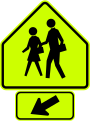
21. This school crossing assembly has a downward diagonal arrow plaque mounted beneath the pentagon. What does the arrow indicate?
- The exact crosswalk where children cross the road. (correct)
- The direction to the nearest school building.
- A school zone somewhere ahead on the road.
- The side of the road where children walk to school.
Why: The arrow on this assembly points to the exact crosswalk where children cross the road, which is why the assembly is posted at the crossing itself rather than in advance of it. The wrong answer to watch for is the one that treats the sign as a warning of a zone somewhere ahead; that describes the plain pentagon school sign posted before you reach the area, not this arrow-plaque version posted at the crosswalk.
Source: Manual on Uniform Traffic Control Devices, sign S1-1+W16-7P (School Crossing Assembly).
-
22. What should you do when this Hill sign warns of a downgrade ahead?
- Reduce speed and shift to a lower gear before starting down. (correct)
- Stop completely at the crest before beginning the descent.
- Yield to any vehicles climbing the grade from below.
- Hold your speed and rely on the brakes throughout the descent.
Why: The Hill sign warns that a steep downgrade is ahead, and the safe response is to slow down and shift to a lower gear before you start down so engine braking helps control your speed. The answer that says to hold your speed and rely on the brakes is the trap: it borrows the everyday habit of tapping the brakes on a mild slope, which lets the brakes overheat and fade on a real grade.
Source: Manual on Uniform Traffic Control Devices, sign W7-1 (Hill).
-
23. You are in the left lane and see this sign in a work zone. What does it require of you?
- Signal, match traffic speed in the right lane, and merge right before the taper. (correct)
- Stop at the taper and wait for a gap in traffic before merging.
- Race to the taper and cut in ahead of continuing traffic.
- Stay in the left lane; traffic in the right lane must yield to you.
Why: In a work-zone lane closure, the driver in the ending lane signals, matches the speed of the through lane, and merges right well before the taper. Racing to the taper and cutting in ahead of continuing traffic tempts drivers who treat the closure as a chance to gain position, the aggressive habit this advance warning is placed to prevent.
Source: Manual on Uniform Traffic Control Devices, sign CW4-2L (Lane Ends Merge Right (Work Zone)).
-
24. A city street lane is painted solid red across its full width and posted as a bus and transit-only lane. What does this require of you in a private car?
- Stay out of the lane except for a permitted right turn or to enter or leave a driveway. (correct)
- Use the lane whenever you're carrying two or more passengers as a high-occupancy vehicle.
- Use the lane during off-peak hours when transit service is running lightly.
- Treat the red pavement as a warning of construction or roadwork ahead.
Why: A red-colored lane is reserved for buses and other authorized transit vehicles, and a private driver stays out except for the brief moment needed to make a permitted right turn or to enter or leave a driveway. What counts as permitted is set by the regulatory signs at the lane and by any dotted or broken section of the red pavement; you cross only where those mark the entry as allowed, not on a private judgment about traffic being light. The pull toward the HOV answer comes from carrying over the diamond-lane habit that occupancy alone earns access, but a red transit lane is controlled by its transit-only signs and markings, and the number of passengers on board changes nothing about who may drive there.
Source: Manual on Uniform Traffic Control Devices, marking 3D.02 (Red-Colored Bus / Transit-Only Lane).
-
25. You see this sign as one of a series posted along the outside of a curve. What does the series tell a driver?
- The direction and sharpness of the curve ahead. (correct)
- The end of a passing zone.
- The edge of the pavement where the shoulder drops off.
- The location of a driveway on the right side.
Why: A row of chevrons along the outside of a curve gives drivers a continuous visual indication of the curve's direction and sharpness, and each panel guides your eye through the bend as you slow down. The pavement-edge choice leans on the fact that the panels stand in a line along the shoulder, but chevrons face into the traffic to trace the curve itself, not to mark where the paved surface ends.
Source: Manual on Uniform Traffic Control Devices, sign W1-8R (Chevron Alignment (Right)).
Keep going.
Want explanations one question at a time? Browse every South Carolina practice question or jump into the topic study guide.