Texas Practice Test
A full-length practice test for the Texas DPS knowledge test.
25 Questions Click an answer to reveal the explanation








Texas Practice Test (25 questions). Correct answers and explanations are noted under each question.
-
1. How must an original Texas driver license application be submitted?
- In person at a driver license office (correct)
- By mail with notarized forms
- By phone through DL RENEW
- Online at the DPS portal
Why: Original driver license applications must be made in person at a driver license office. Choice D tempts drivers who assume any government paperwork can now be done online, but Texas reserves the online channel for eligible renewals and replacements, not first-time originals.
Source: Texas Driver Manual, "Applying for a Texas Driver License," p.6.
-
2. Driving around a barricade that has been placed where water is over any portion of a road is punishable by what?
- Up to $2,000, up to 180 days in jail, or both (correct)
- A $500 fine and 30 days in jail
- A fine of $1 to $200
- A written warning if no crash results
Why: The manual escalates this offense to a Class B misdemeanor punishable by a fine of up to $2,000, up to 180 days in jail, or both. Drivers who read the $1-to-$200 base fine one paragraph earlier and stop there pick C, because the flooded-road escalation sits in a separate sentence right after that base-fine line.
Source: Texas Driver Manual, "Chapter 5: Signals, Signs, and Markers (Obey Warning Signs and Barricades)," p.37.
-
3. You are driving on a through street and approach an intersection with a green horizontal rectangle sign posted overhead. What does this D3-1 street name sign identify?
- The name of the cross street you are about to reach at the intersection. (correct)
- The name of the street you are currently traveling along right now.
- The remaining distance to the next town along your current route.
- The number of a numbered highway route you are approaching soon.
Why: A D3-1 street name sign is a guide sign posted at an intersection, and on a through street it names the cross street you are about to reach so you know which turn is coming up. The tempting wrong pick is the choice about the street you're currently on, which mirrors how a passenger reads a street sign on a residential block as confirmation of the road the car is already on; at a through-street intersection the D3-1 label goes to the crossing roadway instead.
Source: Manual on Uniform Traffic Control Devices, sign D3-1 (Street Name Sign).
-
4. Which of the following is one of the three ways the Texas manual says safety belts help you?
- They cut fuel flow after a rollover.
- They keep you in better control of your car. (correct)
- They inflate the front airbag on impact.
- They lock the doors during a collision.
Why: The manual lists three specific ways belts help: they keep you from being thrown from the car, from hitting the dashboard too hard, and in better control of your car. Test-takers used to modern car ads reach for the airbag deployment option, but the airbag is a separate device with its own glossary entry, not one of the belt benefits.
Source: Texas Driver Manual, "Safety Belts," p.64.
-
5. A lane is marked on the pavement with a white arrow that points both left and right. What does this require of a driver in that lane?
- Turn left or turn right; going straight is not allowed. (correct)
- Turn left only, since the left arrow has priority.
- Continue straight or turn, based on traffic conditions.
- Yield to oncoming traffic before choosing a direction.
Why: A two-headed arrow marks a mandatory-turn lane: a driver in that lane must go left or right, and continuing straight is not permitted. The trap is the option that keeps straight on the table as a traffic-dependent choice, which is how a shared through-and-turn lane works. This marking is not shared. The lane is dedicated to turning, and the through movement has been ruled out before the stop bar.
Source: Manual on Uniform Traffic Control Devices, marking 3B.24 (Left-or-Right Turn Arrow).
-
6. You see a yellow sign posted at a highway exit ramp showing a speed number. According to the Texas manual, what does that number indicate?
- The mainline speed limit you must return to
- The maximum legal speed limit on the ramp
- The speed at which the ramp may be traveled safely (correct)
- The minimum speed required to use the exit ramp
Why: The number on a yellow exit-ramp sign shows the speed at which the ramp may be traveled safely. Choice B is the trap for drivers who read every posted speed number as a legal maximum: the habit works on white regulatory signs and fails on yellow advisory panels.
Source: Texas Driver Manual, "Regulatory and Warning Signs," p.30.
-
7. You are 17 and driving in Texas. When may you legally use a cell phone?
- Only when the car is stopped at a light.
- Only for calls to a parent or guardian.
- Only on hands-free calls.
- During an emergency. (correct)
Why: Under 18, using a cell phone while driving is illegal even hands-free, except for emergencies. Drivers reaching for C lift the adult hands-free carve-out onto a driver the rule specifically excludes from it.
Source: Texas Driver Manual, "Highway Safety Tips," p.48.
-
8. Two parallel solid white lines separate lanes traveling in the same direction. What do they require of a driver in one of those lanes?
- Remain in your current lane and do not cross the marking. (correct)
- Change lanes only when a driver behind you signals to pass.
- Yield to the adjacent lane, then merge across when it is clear.
- Cross only to enter or exit a carpool lane on the left.
Why: Two solid white lines forbid lane changes, so you stay in your current lane until the marking becomes a broken or single line. The trap is the carpool-lane answer: this pattern often runs along the edge of an HOV or managed lane, and a driver eligible for that lane assumes eligibility lets them slip across the paint. The line itself is the barrier, and entry to the HOV lane happens only where the marking changes.
Source: Manual on Uniform Traffic Control Devices, marking 3B.04 (Double Solid White Lane Line).
-
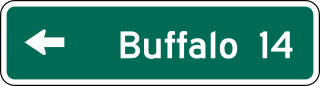
9. You approach an intersection and see this destination sign. What does its arrow refer to?
- The direction to follow from that intersection to reach the named place. (correct)
- The road you are already traveling on toward the named place.
- The compass direction of the destination from your position.
- The name of the road that leads to the destination.
Why: The arrow on a destination sign posted at an intersection shows the direction to follow from that intersection to reach the named place, whether that direction is a left turn, a right turn, or straight ahead. Distractor B tempts drivers who carry over the habit of reassurance markers on a through highway, where an arrow only confirms that the road they are already driving still heads the right way.
Source: Manual on Uniform Traffic Control Devices, sign D1-1a (Destination and Distance Sign).
-
10. What does this blue service sign with a white Rx symbol tell you?
- A pharmacy is available ahead. (correct)
- A hospital emergency department is ahead.
- A staffed first-aid station is ahead.
- A drugstore that stocks only over-the-counter remedies is ahead.
Why: The white Rx on a blue square is the federal services sign for a pharmacy, sitting in the same blue services family as the white H for a hospital and the knife-and-fork for a food service. Drivers who read 'drugstore' as an everyday synonym for pharmacy reach for the over-the-counter-only shop, forgetting that the Rx pictograph points at a prescription counter, not at any corner store stocking aspirin.
Source: Manual on Uniform Traffic Control Devices, sign D9-20 (Pharmacy).
-
11. What does this Fresh Oil sign require of a driver approaching the treated pavement?
- Brake and steer gently and leave extra following distance behind the vehicle ahead. (correct)
- Maintain highway speed since the treatment sets quickly under traffic.
- Stop before entering the treated section and wait for a flagger to wave you through.
- Change to the adjacent lane to avoid driving on the fresh surface.
Why: The sign marks a surface treatment that has just been laid down and has not yet set, so the pavement offers much less grip than it looks like it should. Brake and steer gently, and leave extra following distance so loose chips and oil thrown up by the vehicle ahead don't reach your windshield. The trap is the choice that turns the sign into a flagger cue and stops the driver; every orange work-zone diamond is a hazard warning, not a traffic-control order, and nothing on this one directs a halt.
Source: Manual on Uniform Traffic Control Devices, sign W21-2 (Fresh Oil).
-
12. According to the Texas manual, how do your chances of being killed change if you are thrown from your car?
- You have a slightly higher risk of serious injury.
- Your chance of being killed is five times greater. (correct)
- Your chance of survival improves outside a burning car.
- Your risk of neck injury doubles compared to belted riders.
Why: The manual gives the figure directly: your chance of being killed rises to five times greater when you are thrown from the car. It is one of the three specific ways safety belts protect you. Drivers who land on D reach for the 'twice as likely' phrase they hear in casual seatbelt talk, and it lands well short of the manual's number.
Source: Texas Driver Manual, "Safety Belts," p.64.
-
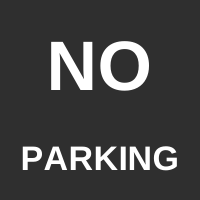
13. A white 'NO PARKING' legend is painted on the pavement along the curb ahead. What does it require of you?
- Park briefly if you leave your hazard lights on.
- Do not park a vehicle in that space. (correct)
- Park there outside posted business hours.
- The prohibition applies only during posted rush hours.
Why: The painted NO PARKING legend means you cannot park a vehicle in that space; treat it the same way you would a posted No Parking sign. The idea that flashing hazard lights buy you a quick stop is borrowed from delivery vans double-parking, and the painted word does not read blinkers.
Source: Manual on Uniform Traffic Control Devices, marking 3B.20 ("No Parking" Pavement Word Marking).
-
14. What is Texas's minimum required liability coverage for injury or death of one person in a single crash?
- $30,000 (correct)
- $60,000
- $15,000
- $25,000
Why: Texas sets $30,000 as the minimum liability limit for injury or death of one person, the first line of the three-line coverage list under the Safety Responsibility Act. The $25,000 in D is the property-damage minimum printed one row below, which readers often lift when they scan the list and stop at the first small number.
Source: Texas Driver Manual, "The Liability Insurance Law," p.18.
-
15. A regulatory sign along the shoulder of a Texas highway restricts shoulder use to which drivers?
- Buses picking up or dropping off passengers.
- Vehicles stopped for a breakdown, flat tire, low fuel, or other emergency. (correct)
- Slow-moving farm equipment and construction vehicles.
- Vehicles preparing to make a right turn at the next intersection.
Why: The manual limits the shoulder to drivers who have stopped for a real problem: a breakdown, a flat tire, an empty fuel tank, or a similar emergency. Choice D is the pull for the driver who has slid onto the shoulder to line up a right turn and treats that habit as sanctioned; the manual does not list it.
Source: Texas Driver Manual, "Regulatory and Warning Signs," p.31.
-
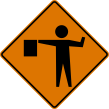
16. You pass a Flagger Ahead sign and enter the work zone. A flagger in the zone waves you through the intersection while the traffic light ahead shows red. What are you required to do?
- Stop for the red light; the traffic light has final authority.
- Follow the flagger's signal and proceed through the intersection. (correct)
- Stop and wait until the signal turns green, then proceed.
- Proceed only if the flagger and the signal both permit it.
Why: A flagger's directions legally override even a traffic light, so when the flagger in the work zone waves you through, you drive past the red. Drivers who stop for the red anyway fall back on the everyday rule that a steady red is always absolute, and miss that the orange diamond warned of a flagger whose directions now outrank the light.
Source: Manual on Uniform Traffic Control Devices, sign W20-7 (Flagger Ahead).
-
17. According to the Texas manual, what three things must you do when leaving your vehicle?
- Turn the motor off, roll up the windows, and lock the doors
- Turn the motor off, set the parking brake, and remove the key (correct)
- Set the parking brake, shift into neutral, and remove the key
- Turn the motor off, remove the key, and leave the hazard lights on
Why: The manual's Chapter 7 opens by naming the three things a driver does on leaving the vehicle: turn the motor off, set the parking brake, and remove the key. Rolling up windows and locking the doors is a habit worth having, and a driver who picks A is defaulting to the routine their parents taught rather than to what this section actually lists.
Source: Texas Driver Manual, "Chapter 7: Parking, Stopping, or Standing," p.41.
-
18. Your rear tires break loose and the car begins to skid. Which way does the manual tell you to turn the steering wheel?
- Turn opposite the skid to catch the slide.
- Hold the wheel straight and brake hard.
- Turn the wheel in the direction of the skid. (correct)
- Turn slightly away while giving light throttle.
Why: The manual tells you to turn your steering wheel in the direction of the skid, which lets the front tires realign with the car's actual path. Option A comes from the intuitive habit of pointing the car where you want it to go, which is the opposite of what recovers a skid.
Source: Texas Driver Manual, "Chapter 9: Some Special Driving Situations - Steering Out of a Skid," p.48.
-
19. A striped barricade in a Texas work zone has diagonal stripes sloping downward to the right. What are you being told to do?
- Reverse to the previous exit
- Bear to the right (correct)
- Bear to the left
- Stop and wait for a signal
Why: The manual reads the diagonal stripes as an arrow pointing where traffic should go, so a downward-right slope steers you to the right. Drivers who pick 'bear to the left' read the stripe like a chevron sign, taking the raised upper-left end as the arrow's point and heading toward it instead of following the slope down.
Source: Texas Driver Manual, "Chapter 5: Signals, Signs, and Markers (Channelizing Devices, Pass to the Right)," p.36.
-
20. A white PED XING legend is painted in your travel lane. What does this marking tell you?
- A marked crosswalk is ahead. (correct)
- The lane is reserved for pedestrian use only.
- You are entering a school zone.
- Pedestrians must yield to vehicles crossing here.
Why: PED XING is the pavement abbreviation for pedestrian crossing, painted white in the travel lane to give drivers advance notice that a marked crosswalk is ahead. The trap is the answer that treats a word painted in the travel lane as reserving that lane for pedestrian use, the way a BUS ONLY legend does; PED XING is a warning aimed at approaching drivers, not a lane designation.
Source: Manual on Uniform Traffic Control Devices, marking 3B.21 (PED XING Pavement Legend).
-
21. According to the manual, how long does the average person take to think, react, and apply the brakes?
- Under one second on average
- Roughly three seconds
- About a second and a half (correct)
- Half a second on average
Why: The Approximate Stopping Distances page opens by telling drivers it takes the average person one and a half seconds to think, react, and apply the brakes, and the whole stopping table is built on that count. Rounding the figure down to a clean whole number is the mental shortcut behind A, the sort of quick estimate drivers reach for on the fly.
Source: Texas Driver Manual, "Approximate Stopping Distances," p.45.
-
22. A center travel lane is bordered on each side by an outer solid yellow line and an inner broken yellow line. What is this lane used for?
- Left turns by traffic traveling in either direction. (correct)
- Passing slower vehicles when the adjacent through lane is blocked.
- Left turns made only by oncoming traffic from the opposite direction.
- Through travel to bypass congestion in the adjacent lane.
Why: A center lane bordered by outer solid and inner broken yellow lines is a two-way left-turn lane, used by traffic from both directions only to make left turns. The trap is the choice that treats the broken yellow line as a passing line; on a two-lane road a broken yellow line does permit passing, but here the broken line only marks where vehicles may cross into the lane to turn left, and passing inside the lane is not allowed.
Source: Manual on Uniform Traffic Control Devices, marking 3B.05 (Two-Way Left-Turn Lane).
-
23. What does the Texas manual say about a driver who slows down at a stop sign instead of stopping completely?
- Slowing to five miles per hour satisfies the requirement.
- Slowing is enough if no pedestrians are present.
- Slowing to walking speed is acceptable if the intersection is clear.
- Slowing down is not adequate; a complete stop is required. (correct)
Why: The stop sign requires a full stop before you proceed: the manual states it in one blunt sentence and applies it to every vehicle that reaches the sign. Choice C is the trap for the driver who's drifted through enough empty side streets that a slow roll now feels like a clean stop at any sign.
Source: Texas Driver Manual, "Regulatory and Warning Signs," p.30.
-
24. You are driving on a two-lane road that meets a divided road with three lanes going the same direction. No signs or signals control the intersection. Who has the right-of-way?
- Vehicles on the three-lane road have the right-of-way. (correct)
- Vehicles on the two-lane road, since it is the narrower one.
- Vehicles on the two-lane road, since they arrived first.
- Whichever vehicle is turning has the right-of-way here.
Why: At an uncontrolled intersection where a single or two-lane road meets a divided or three-or-more-lane road, the driver on the two-lane road yields to traffic on the wider road. Drivers who fall back on the four-way-stop habit of "whoever got here first goes" pick option C, but arrival order does not settle a lane-count crossing.
Source: Texas Driver Manual, "Chapter 4: Right-of-Way, Single or Two-Lane Road Intersecting a Multi-Lane Road," p.20.
-
25. According to the manual, what happens when drivers react a half-second slower because of distractions?
- Reaction time doubles.
- Crashes double. (correct)
- Fatal crashes rise by half.
- Stopping distance triples.
Why: The manual states that a half-second delay in reaction from distractions doubles crashes. The D answer comes from blending the reaction-delay claim with braking-distance figures from other chapters that treat speed and skid separately, ending on a stopping measure instead of a crash count.
Source: Texas Driver Manual, "Distracted driving," p.53.
Keep going.
Want explanations one question at a time? Browse every Texas practice question or jump into the topic study guide. Ready to close the gaps for good? Own the Texas book and its study system.