Texas Driver's Permit Diagnostic Quiz
Find your weak spots before you book the test. 10 questions drawn from the topics the Texas driver manual spends the most time on. You'll see which topics need work the moment you finish; enter your email at the end and we'll send the full ranked plan with exact scores and the chapters to study next.
Texas Driver's Permit Diagnostic Quiz (10 questions). Correct answers and explanations follow each question.
-
1. You are driving on a street that dead-ends at a through street. What must you do at the T-intersection?
- Proceed first if you reach the intersection ahead of any car.
- Stop and yield to vehicles on the through street. (correct)
- Slow down and merge into the flow of the through street.
- Yield only when a yield sign faces you at the corner.
Why: At a T-intersection where your street ends, the manual requires you to stop and yield to any vehicle on the through street. Wrong answer C tempts a driver whose on-ramp habit is to roll into flowing traffic without stopping; that habit does not survive at a T-intersection.
-
2. According to the Texas manual, what sign shape is used exclusively for stop signs?
- Diamond
- Octagon (correct)
- Equilateral triangle
- Pentagon
Why: The manual's shape table assigns the octagon exclusively to stop signs, which is why a driver can identify the rule from a distance before reading the word STOP. The trap is equilateral triangle: it sits one row above in the same 'exclusively' list and is the other shape a learner memorizes as an exact-match pair with stop, so the two get swapped in recall.
-
3. You approach an intersection controlled by a flashing yellow light. According to the Texas manual, what should you do?
- Yield only to vehicles already in the intersection.
- Maintain speed and drive straight through.
- Slow down and proceed with caution. (correct)
- Stop completely, then proceed when clear.
Why: A flashing yellow warns drivers to slow down and proceed with caution. Option D is the trap for drivers who treat every flashing signal alike; the stop-then-go rule belongs to flashing red, not flashing yellow.
-
4. Your road is unpaved and it crosses a paved road at an intersection with no signs or signals. Who has the right-of-way?
- The driver going straight through the intersection.
- Vehicles on the paved road have the right-of-way. (correct)
- Whichever driver reaches the intersection first has priority.
- Vehicles on the unpaved road, because they have less traction.
Why: Where an unpaved road meets a paved road, the unpaved-road driver yields to traffic on the paved road, no matter who reached the intersection first. The pavement rule settles the question before the right-side rule for uncontrolled intersections ever comes into play. Wrong answer C applies the four-way-stop habit of letting whichever driver arrived first proceed, which the paved-road rule overrides.
-
5. According to the Texas manual, what sign shape is used exclusively for yield signs?
- Regular octagon
- Circular disc
- Equilateral triangle (correct)
- Warning pennant
Why: The manual's shape table gives the equilateral triangle to yield signs and to no other sign type, so a driver reads the yield rule from the shape alone. The trap is octagon: it is the other single-purpose shape listed in the same 'exclusively' entries, so a learner grouping the two together as memory partners swaps which shape carries which rule.
-
6. You see a series of solid white triangles painted on the pavement ahead, all pointing in your direction of travel. What are these markings telling you?

- A speed hump or speed table; slow before you cross it. (correct)
- A pedestrian crossing ahead; yield to anyone in it.
- A railroad crossing ahead; stop if a train is near.
- A lane ending ahead; merge into the next lane.
Why: A row of solid white triangles pointing in your direction of travel warns of a speed hump or speed table ahead, so slow to the posted advisory speed before you cross. The pedestrian-crossing answer is the trap: a crosswalk uses parallel white bars or blocks straight across the road, and drivers who read any bold white pavement pattern as a crosswalk cue miss that these triangles point along the lane, not across it.
-
7. The signal ahead changes from green to steady yellow as you approach the intersection. According to the Texas manual, what does the yellow require?
- Speed up to clear the intersection before the light turns red.
- Stop before the nearest crosswalk if you can do so safely. (correct)
- Slow down slightly and hold your speed until the red appears.
- Continue at your current speed since yellow is still a go signal.
Why: A steady yellow means stop before the nearest crosswalk if the stop can be made safely; only when a safe stop is impossible do you proceed cautiously through. Option A is the trap for drivers running on the 'beat the yellow' habit, which trades a legal stop for a red-light entry.
-
8. According to the manual's glossary, what does a minimum speed limit exist to do?
- Mark the school-zone reduction during school hours.
- Set the fastest speed a beginner may drive.
- Keep traffic moving safely by preventing very slow driving. (correct)
- Mark the reduced speed used during rain.
Why: The manual's glossary defines a minimum speed limit as a rule that keeps traffic moving safely by not letting drivers go slower than a certain speed. Choice D tempts drivers who assume any word 'minimum' near speed refers to weather-adjusted driving, because rain and fog training centers on 'slow down' as the default speed action and the two concepts get filed together.
-
9. A white PED XING legend is painted in your travel lane. What does this marking tell you?
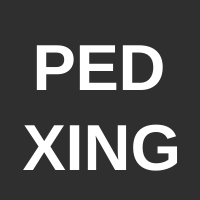
- A marked crosswalk is ahead. (correct)
- The lane is reserved for pedestrian use only.
- You are entering a school zone.
- Pedestrians must yield to vehicles crossing here.
Why: PED XING is the pavement abbreviation for pedestrian crossing, painted white in the travel lane to give drivers advance notice that a marked crosswalk is ahead. The trap is the answer that treats a word painted in the travel lane as reserving that lane for pedestrian use, the way a BUS ONLY legend does; PED XING is a warning aimed at approaching drivers, not a lane designation.
-
10. According to the Texas manual, which kinds of posted speed limits must drivers obey?
- Only signs posted inside cities and towns.
- Both minimum and maximum posted limits. (correct)
- Only the limit posted on numbered highways.
- Only signs that show a maximum in mph.
Why: The manual's Speed Limits section opens by requiring drivers to obey posted minimum AND maximum limits. Choice D tempts drivers who think of a speed limit only as a ceiling; those drivers have never noticed the separate minimum-speed signs Texas posts on some higher-speed highways to keep traffic moving.
Where to go next.
Ready for a longer go? Take the full Texas practice test or jump into the topic study guide.
This diagnostic is one snapshot. The Texas book unlocks a companion that turns it into a ranked study plan and re-ranks your weakest topics every time you practice, so the top of the list is always what to drill next. Own the Texas book to unlock it.